Get Full Government Meeting Transcripts, Videos, & Alerts Forever!
Get email alerts on the Landing Fees topic
No spam. Unsubscribe anytime.
Naples Airport Authority delays landing‑fee plan after legal, tenant and community pushback
Summary
After public objections and legal caution from authority counsel, the Naples Airport Authority agreed to pause a proposed landing‑fee rollout and directed staff to refine options and return next month; counsel warned fees intended to 'discourage' curfew violations could trigger a Part 161 study and conflict with FAA grant assurances.
The Naples Airport Authority on Thursday postponed a decision on proposed landing fees after a lengthy debate that underscored legal limits, tenant opposition and unresolved questions about how to target costs fairly.
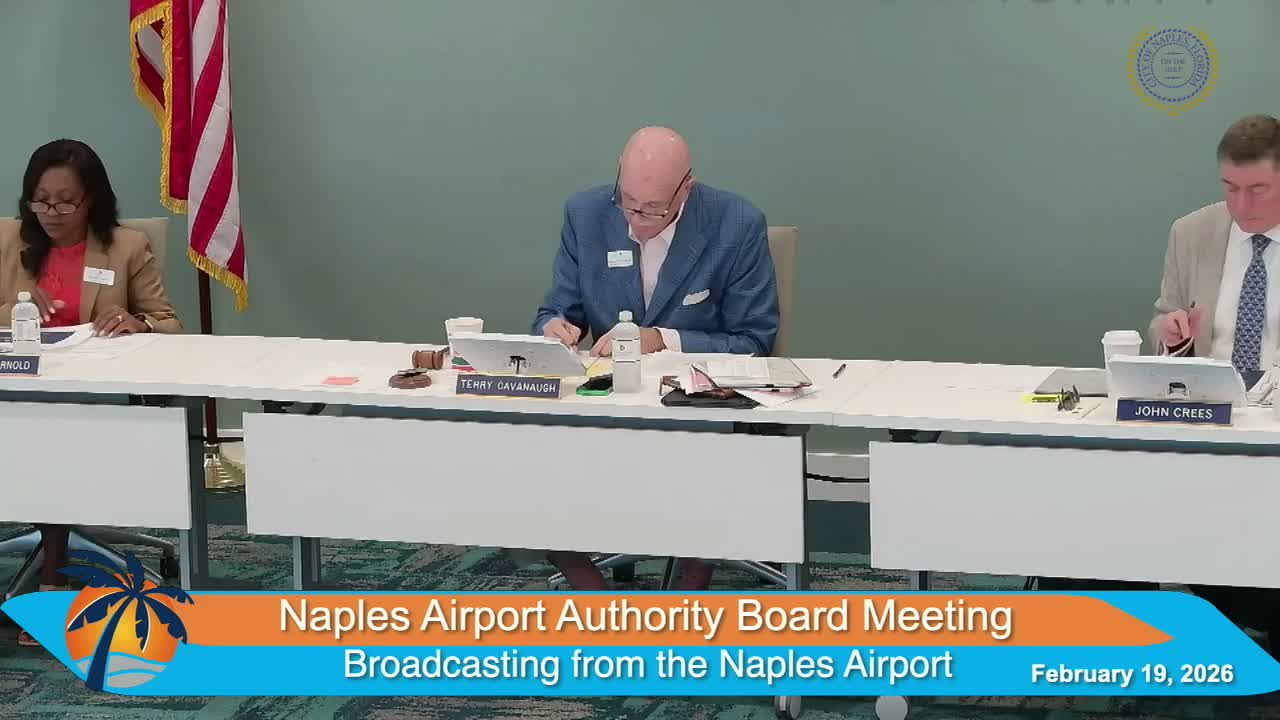
Chair Terry Kavanaugh opened discussion after staff presented two fee models: charging all landings (illustrated as $5 per $1,000 of aircraft weight, $10 minimum) that staff estimated could generate about $1.7 million for the remainder of the fiscal year, or charging only transient aircraft, a change staff projected would yield roughly $900,000 while adjusting the fuel‑embedded airfield cost recovery fee downward to keep the budget revenue‑neutral. Ken Warner, the authority’s senior director of finance and administration, also outlined a five‑year capital forecast that included about $110 million of expected projects.
Many tenants and aviation groups urged caution. Keith West of the Airport Tenants Council told commissioners he and the council were "implacably" opposed to landing fees and said the underlying problem is spending, not revenue; he said personnel costs rose about 139% from 2020 to 2024. Jose Carrera of the Naples Jet Center and the Florida Aviation Business Association said the airport already achieves very high curfew compliance and questioned whether landing fees would be necessary or fair.
Legal counsel flagged multiple constraints. Peter Kirsch, the authority’s aviation counsel, said a landing fee adopted with the purpose of "discouraging" curfew violations risks converting a voluntary curfew into a de facto access restriction and therefore would typically require a Part 161 study before implementation. He also cautioned that, as a general matter, distinguishing between transient and based aircraft for landing‑fee purposes is impermissible unless there is a direct contractual relationship (for example, an aircraft owner who leases space from the authority) that justifies a lease‑based credit.
"If you are imposing a landing fee with the purpose of discouraging curfew violations, you need to go through a Part 161 study before you're allowed to do that," Kirsch said. "You certainly can charge fees for certain kinds of operations, but not if the basis is to discourage those operations."
Board members described competing priorities. Several commissioners said they wanted to recover the roughly $12 million in annual airfield costs fairly and to ensure those who impose disproportionate noise or costs shoulder an appropriate share. Others warned against framing the proposal as a "revenue grab" and urged caution because of federal obligations tied to FAA grant assurances.
After the discussion, the board did not vote to adopt landing fees. Chair Kavanaugh said staff should continue to refine fee options and legal analysis and that the action item to hire a third‑party billing firm would be tabled to a future meeting. "I think we've provided some good feedback today," Mr. Radzanski, the authority’s executive director, said. "We will bring a further refinement back to the next meeting."
What’s next: Staff will work with counsel to model options that comply with FAA policy, clarify whether a targeted fee structure could be implemented without triggering a Part 161 process, and present refined proposals at a future meeting. The authority also signaled interest in exploring returning recovered costs — and any distribution mechanics — in ways that are equitable to local tenants.