Get Full Government Meeting Transcripts, Videos, & Alerts Forever!
Get email alerts on the Infrastructure Los topic
No spam. Unsubscribe anytime.
Planning board accepts Level of Service reports as staff warns of water-quality and traffic data gaps
Summary
The board voted to accept the city's Level of Service reports and forward them to City Council; City staff and the public flagged infrastructure funding needs, emerging-contaminant testing for reclaimed water, and traffic-count data gaps that will shape upcoming policy updates.
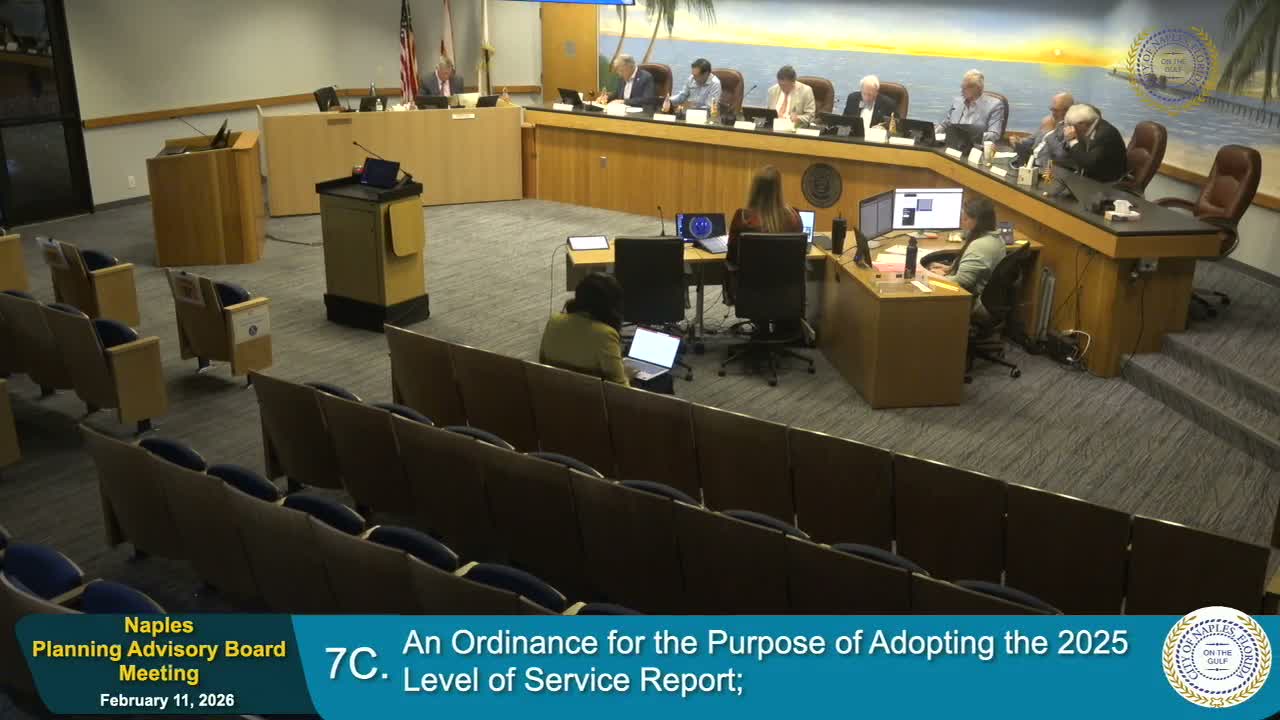
The Planning Advisory Board voted to accept the City of Naples—s annual Level of Service (LOS) reports and forward them to City Council, after an extended discussion about infrastructure capacity, data quality and funding priorities.
Erica Martin, planning director, explained the LOS reports cover potable water, sanitary sewer, drainage, solid waste and transportation. "The purpose of these reports is to identify any current or potential deficiencies given the population projections for the service area and provide remedies for the deficiencies," Martin said. The board—s vote advances the reports to City Council for the statutory first reading; remedies and mitigation measures would be discussed at the Council's second reading.
Public Works Director Dr. George Yilmaz told the board the city meets concurrency for water quantity but urged a greater focus on water quality and distribution reliability. He said the utility meets primary regulated standards and produces what he described as "irrigation-quality" reclaimed water but cautioned that existing treatment systems may not remove some emerging contaminants (PFAS, pharmaceuticals, microplastics). "My first answer is most likely not," Yilmaz said when asked whether current systems remove those contaminants; he said the city has hired a consultant to study post-treatment options and the potential need to phase in user-rate adjustments to fund upgrades.
Yilmaz also outlined stormwater funding moves: a phased stormwater-fee increase and an enterprise funding model that have together produced borrowing capacity and an initial $64 million allocation for an eight-year execution horizon, with $3 million to $6 million earmarked in the current and next fiscal-year budgets for design work on large basins.
Transportation staff presented the traffic portion of the LOS. City engineer and transportation manager Lisonbee Beckett said the city—s adopted LOS for vehicular traffic on city streets is level of service C and that arterial streets currently show modest growth. However, staff and multiple board members emphasized directional peak-volume analysis (peak in one direction) rather than two-way totals as more revealing of localized congestion and safety impacts. Staff described recent gaps in traffic-count data caused by vandalism and firmware failures and said the city ordered AI-based counters to provide continuous, directional monitoring.
Board members pressed staff for clearer public-facing summaries, maps of service-area boundaries and direct links to source data. Several members urged the department to require traffic studies to define peak hours explicitly and to incorporate directional counts when evaluating development impacts. Staff agreed to add maps and improve data accessibility; they also said consultants (Johnson Engineering) are incorporating directional analysis and proposed clearer traffic-impact-study thresholds and study-area rules to present to council in March.
The board also heard suggestions for broader planning work: a city solid-waste master plan to address landfill dependency, and coordination with Collier County on regional capacity and alternatives including energy-from-waste. Planning staff informed members about upcoming comp-plan draft presentations at the March 11 meeting and public engagement sessions scheduled the following day.