Get Full Government Meeting Transcripts, Videos, & Alerts Forever!
Get email alerts on the Justice Complex Planning topic
No spam. Unsubscribe anytime.
Williamson County lays out timeline, cost options for new justice complex as commissioners debate location
Summary
County staff presented a multi-phase plan and timeline for a new justice complex, estimated costs and interim options; sheriff and the district attorney described operational constraints in the current jail and courthouse, and the court voted to name the county judge liaison for planning the historic courthouse.
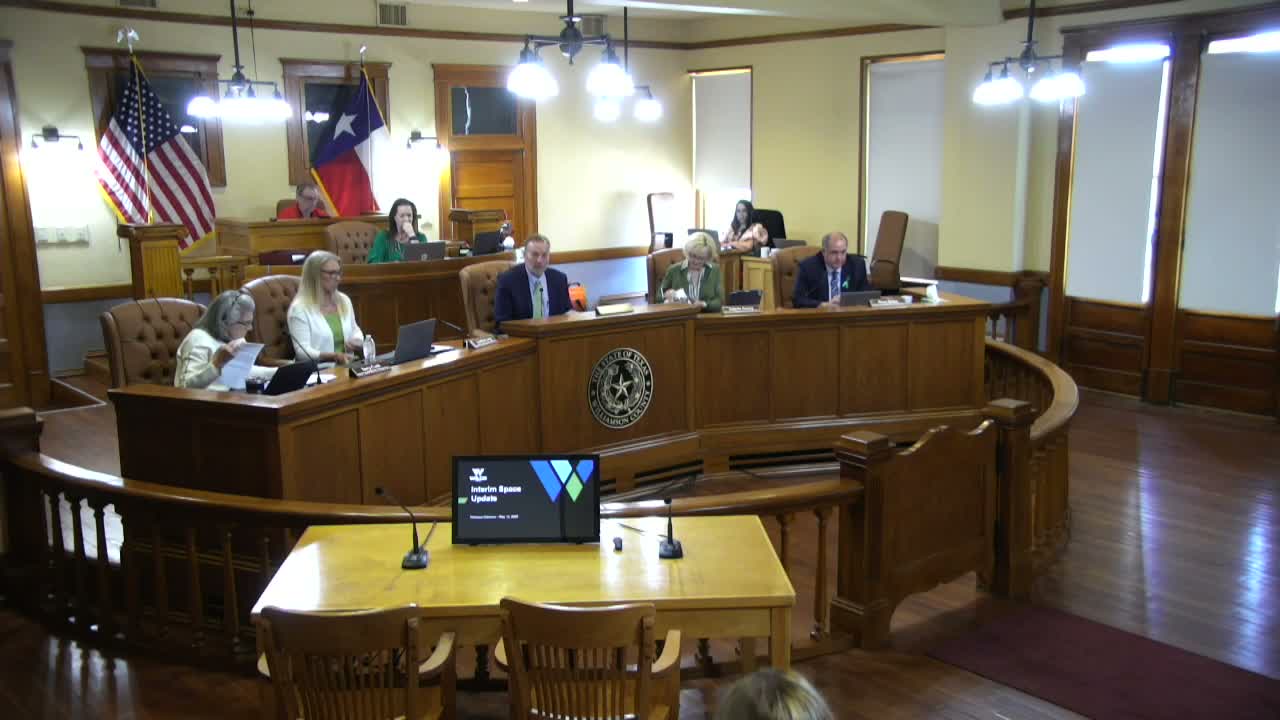
County staff presented options, cost estimates and an accelerated timeline for a new Williamson County justice complex at the May 12 Commissioners Court, and commissioners and public-safety leaders debated trade-offs among cost, timing and proximity to downtown services.
County Manager Rebecca Clemens summarized work to date and explained that moves into the new Administration Building this summer will vacate downtown spaces (historic courthouse, Georgetown Tax Office and several small offices) but that vacating alone will not fill the county’s current shortfall in usable space. She said the proposed interloop "Triangle" property under contract is about 135 acres and would support a multi-phase master plan; staff models used a placeholder facility scenario with a notional $500 million project cost and an estimated land cost near $76 million, but Clemens emphasized these are planning assumptions rather than final prices.
"We are currently in phase 2 of a 6 phase process," Clemens told the court, describing a program that would include new courthouse space, sheriff administration and jail, and expanded lab and evidence space. If the county stays on the proposed timeline, the presentation projected late 2030–early 2031 for an initial completion window, with phasing and escalation risks noted.
Sheriff Matt Lindeman described operational constraints in the existing jail and sheriff’s facilities: a 36-year-old core facility with repeated maintenance issues, water and sewer incidents that displaced staff, an evidence area far smaller than recommended, and booking/intake bottlenecks that sometimes leave deputies waiting for extended periods in the Sally Port. "Our receiving area is so small," Lindeman said, "about two arrestees at a time is all it will currently accommodate," citing daily operational delays and medical transport frequency.
District Attorney Sean (name redacted in the transcript) explained courtroom, staffing and security limitations in the downtown courthouse: growth in caseloads and staff since the building was constructed means courtrooms, circulation, jury and victim spaces and power/information infrastructure are no longer adequate. He said modern design and flexible, phased expansion would better support prosecution, victim services and high-profile cases.
Clemens and facilities director Dale Butler outlined several options: build a new mixed-use justice complex on the interloop site (criminal and civil consolidated), build a criminal-only complex and retain civil downtown (with associated remodeling costs), or invest in substantial downtown additions and long, disruptive remodels to the existing jail and courthouse. The presentation included order-of-magnitude figures such as roughly $1.9M per courtroom to build out current space, $8.25M–$9.0M for certain downtown infrastructure upgrades, and itemized estimates for duplication of services and increased transportation costs if operations were separated.
Commissioners debated pace and sequencing. Some members emphasized the high cost of delay—staff noted construction-cost escalation could erode buying power by roughly 6% annually on a large project—while other commissioners urged more public engagement and additional analysis of interim downtown options before committing to phase 3 of work with design and procurement.
The court took the following formal actions of note during the meeting: - Approved a county minutes motion (recorded as "Motion carries 5 0"). - Approved a line-item transfer for jail needs (item 29) to fund kitchen work, vehicle/radio fees, and medical/hospital line items (motion carried 5-0). - Approved a county commitment to a Safe Streets & Roads for All grant application with a local match contribution (the court recorded "Motion carries 5 0"). - Voted to designate the county judge as the liaison to lead future planning activities for the historic courthouse; the motion passed 5-0.
What the court asked staff to do: Commissioners asked the county manager and facilities team to produce interim move plans for departments shifting into the new Administration Building this summer, to provide cost comparisons for downtown remodeling versus new construction, and to return with firm schedules and cost estimates for phased design and procurement.
Ending: Commissioners reiterated the need to avoid unnecessary delay because of escalating construction costs and asked staff to accelerate planning for the next phase while also improving public outreach and answering outstanding neighborhood questions about site buffers, transport logistics and safety measures.