Get Full Government Meeting Transcripts, Videos, & Alerts Forever!
Get email alerts on the Tax Policy topic
No spam. Unsubscribe anytime.
Negotiators advance list of no‑cost tax fixes while flagging Fridley and Wayzata for follow‑up
Summary
House and Senate staff and leaders met May 12, 2026 to review no‑cost, noncontroversial tax provisions for a 2026 omnibus tax bill; they agreed to send many items to staff for drafting but objected to a Fridley TIF extension and set Wayzata aside pending an amendment.
A legislative tax discussion group met May 12, 2026 to review a staff‑prepared list of no‑cost and noncontroversial items that negotiators hope to fold into a 2026 omnibus tax bill, and members authorized staff to draft language on agreed items while reserving several matters for further work.
The session, convened to speed negotiations between the House and Senate, focused on technical fixes and jurisdictional clarifications rather than new spending. A Department of Revenue analyst, Megan Bursch, described a "technical" clarification to the minerals article (article 10, section 10) that staff said is not substantive and can be made clearer without changing policy. "The Department of Revenue Minerals unit identified an area...that could be a little bit clearer," Bursch said.
Why it matters: negotiators prioritized small, technical changes they consider noncontroversial so staff can draft a clean package and speed floor action. Several items discussed would affect local governments and special districts, production tax proceeds for mining communities, and tax administration rules that affect taxpayers and city reporting.
Key outcomes and items discussed
- Minerals article technical fix: Nonpartisan staff flagged a clarity issue in the minerals article; senators and representatives agreed staff should correct language and move it forward for drafting. Bursch said the change "is not a substantive change" and is intended to make the section on insufficient proceeds clearer.
- Minneapolis tourism district sales tax: Senator Dibble described a fix so the tourism district fee charged on hotel rooms is not itself treated as taxable, avoiding a "tax on tax." He said the change has no cost to the state.
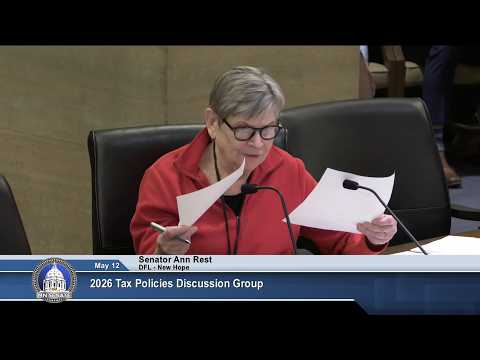
- Refund claim period alignment: Senator Rest proposed aligning the state's refund claim period with the federal two‑year period so taxpayers do not lose refunds because of differing deadlines. Rest said the provision chooses "the federal 2 years rather than 1 year as a period for which a refund...can be applied for so that the taxpayer doesn't lose the refund." Members noted work with the bar association on the provision.
- Tax increment financing (TIF): Members tentatively agreed to include several TIF clarifications and local district items (Mountain Lake, Eden Prairie, Columbia Heights, Chaska, Hopkins) in the agreeable file but objected to extending Fridley. Senator Rest said the Fridley program has not demonstrated success and the senate would oppose its extension. Wayzata was flagged as needing a specific "notwithstanding" amendment to allow use of increment for parks and other uses; negotiators deferred Wayzata pending that amendment.
- Office of State Auditor (OSA) reporting: The OSA proposed streamlining certain TIF reports by allowing a single numeric field to meet reporting requirements; members said the change reduces burden on cities and supported adding it to the package.
- PTE (pass‑through entity) technical items: Department of Revenue staff described three PTE‑related items: (1) credit for tax paid to another state to avoid double taxation; (2) moving the timing of the first estimated payment (a proposed shift that would reduce penalties for taxpayers whose first payment falls in June); and (3) denying an individual credit until a pass‑through entity tax is paid. Joanna Barrett, identified as legislative director for the Department of Revenue, summarized the changes and said one item clarifies denial of credit until a PTE tax is paid.
- Mortgage registry and deed tax: Members corrected the jurisdictional reference to Hennepin and Ramsey counties and agreed to include a conforming extension for the environmental response fund financing.
- Tribal property exemptions and Lake City Port Authority change: Members agreed to add two tribal clinic property exemptions (Duluth and Carlton County) to the agreeable list after staff clarification. A Lake City Port Authority provision that would deny levy authority for that port authority prompted questions about whether the change belongs in the tax bill or in general register; staff will clarify.
- Northern city and property tax task force: Members discussed adding a newly incorporated "Northern" city and noted the city may receive both township aid and local government aid in its first year (one estimate cited a township amount of about $1,300). Lawmakers also discussed constraints on task forces that include legislators and left further structuring to staff.
- Senate‑only and House lists: Negotiators reviewed items labeled "senate only" (including revenue rulings, National Guard income subtraction for border cities, grazing land property tax exemption clarifications and the Blaine taxing district) and several items labeled as 'both bodies' that still need more cross‑chamber conversation.
What did not change: The group did not formally adopt any measures at the meeting; rather, chairs and leaders agreed to authorize senate counsel, house research and Department of Revenue staff to draft language for the items on which there was consensus.
Representative Warwas, speaking for the Iron Range delegation, said the mining revenue provisions are important for local schools and communities: "Bringing that online...will provide stable local revenue, when production begins." On the more contentious Fridley item, Senator Rest said the senate "would not accept Fridley" without further proof the program had succeeded.
Next steps and closing: Staff were authorized to draft technical language for agreed items to accelerate negotiations; members left open follow‑up on Fridley, Wayzata and several other items that need amendment or further cross‑chamber work. The meeting closed with chairs thanking nonpartisan staff for their work and a pledge to continue negotiating toward a robust tax bill.
The group did not take formal votes on the items discussed; items placed in the "agreeable" column were transmitted to counsel and drafting staff for statutory language preparation.