Get Full Government Meeting Transcripts, Videos, & Alerts Forever!
Get email alerts on the Domestic Violence Response topic
No spam. Unsubscribe anytime.
Billings work session on domestic violence focuses on training, GPS monitoring and Brodie’s Law; council to schedule follow-ups
Summary
City officials heard police and prosecutors outline training, arrest and GPS-monitoring practices as survivors and advocates pushed prevention and a draft 'Brodie’s Law' to close family-law gaps; council asked staff to schedule deeper follow-ups on risk assessment, victim advocacy and coresponse.
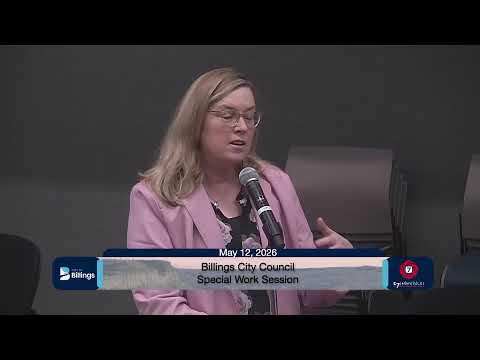
Billings city leaders on Wednesday convened a work session to review how local systems respond to domestic violence, hearing presentations from the police chief and city prosecutors and nearly a dozen public commenters who urged more prevention, survivor-centered services and legislative fixes.
Rich St. John, Billings police chief, told the council that the department has expanded domestic-violence training beyond state minimums — including a 40-hour academy domestic-violence block and additional scenario and Family Justice Center instruction — and is implementing retraining and new policies after identifying procedural gaps. “Domestic violence is among the most dangerous and complex crimes that we face as a department,” St. John said, and he described plans for lethality-assessment expansion, protection-order enforcement and a local domestic-violence fatality-review team.
Deputy city attorney Morgan Licks explained prosecution and release procedures. She said Montana law designates several domestic-related offenses as non‑bondable, meaning many defendants remain in custody until arraignment. Prosecutors prepare bond‑prep packets each morning, tracking evidence, prior history and even jail calls; their release requests commonly include GPS monitoring and other conditions. Licks said prosecutors aim to file expedited petitions or warrants when GPS providers report red‑zone violations and that GPS vendors typically notify the prosecutor’s office the same day such violations are detected.
Survivors and advocates who spoke during two public‑comment periods urged changes that go beyond arrests. Katie Harrison, a Billings resident, told the council a jail sentence can increase danger for some survivors: “If my abuser is put in jail, he's gonna come out angrier at me, and I'm gonna be a greater target.” Several speakers including representatives from the Montana Family Court Awareness Project recommended trauma‑informed training for court staff and judges, use of the Arizona intimate partner risk assessment instrument, and passage of Brodie’s Law, a draft measure intended to close family‑law loopholes that advocates say allow escalation to criminal harm.
A commenter speaking for a local political action committee cited county criminal‑justice data and argued for greater incapacitation of repeat offenders. The speaker said Yellowstone County Detention Facility “regularly houses 650 inmates in a facility whose capacity is 434,” and estimated that 59 percent of violent crime in the county is related to domestic violence; council members pressed staff for numbers and asked the prosecutor’s office about how GPS violations and other compliance failures are tracked and enforced.
Council members asked police and prosecutors about several operational gaps: whether officers who trained in other states receive equivalent domestic‑violence instruction, how supervisors ensure consistent completion of lethality assessments and reports, whether the city should increase patrol staffing or add investigators, and whether pretrial GPS vendors provide victim apps and timely alerts. Police recommended more patrol capacity to allow for longer scenario‑based training; prosecutors said some GPS providers offer apps and that courts or defendants typically select providers, though prosecutors and pretrial supervisors work closely with vendors.
Council staff summarized three near‑term follow‑ups: improving victim notification when defendants are released, reviewing interagency communications (including coordination with the county sheriff and county attorney), and advancing prevention and early‑intervention strategies. The council agreed to schedule additional work sessions that will cover risk and lethality assessment, victim advocacy and coresponse, and a dedicated domestic‑violence response team; staff will coordinate dates and invite county partners.
No formal motions or votes were recorded at the session. The council adjourned after public comment, with members and advocates saying they expect more meetings to flesh out legislative options, data reporting and operational changes.