Get Full Government Meeting Transcripts, Videos, & Alerts Forever!
Get email alerts on the Energy Peakers topic
No spam. Unsubscribe anytime.
Austin Energy staff urges authorization to pursue up to 400 MW of natural‑gas peakers; commissioners press for more analysis and stronger guardrails
Summary
Austin Energy presented modeling showing substantial reliability and financial risk without new local dispatchable generation and recommended authorizing negotiations to secure up to 400 MW of efficient natural‑gas peaker units to reduce modeled risk and market exposure; commissioners and public commenters pressed for greater transparency, alternatives analysis and tighter emissions and siting guardrails.
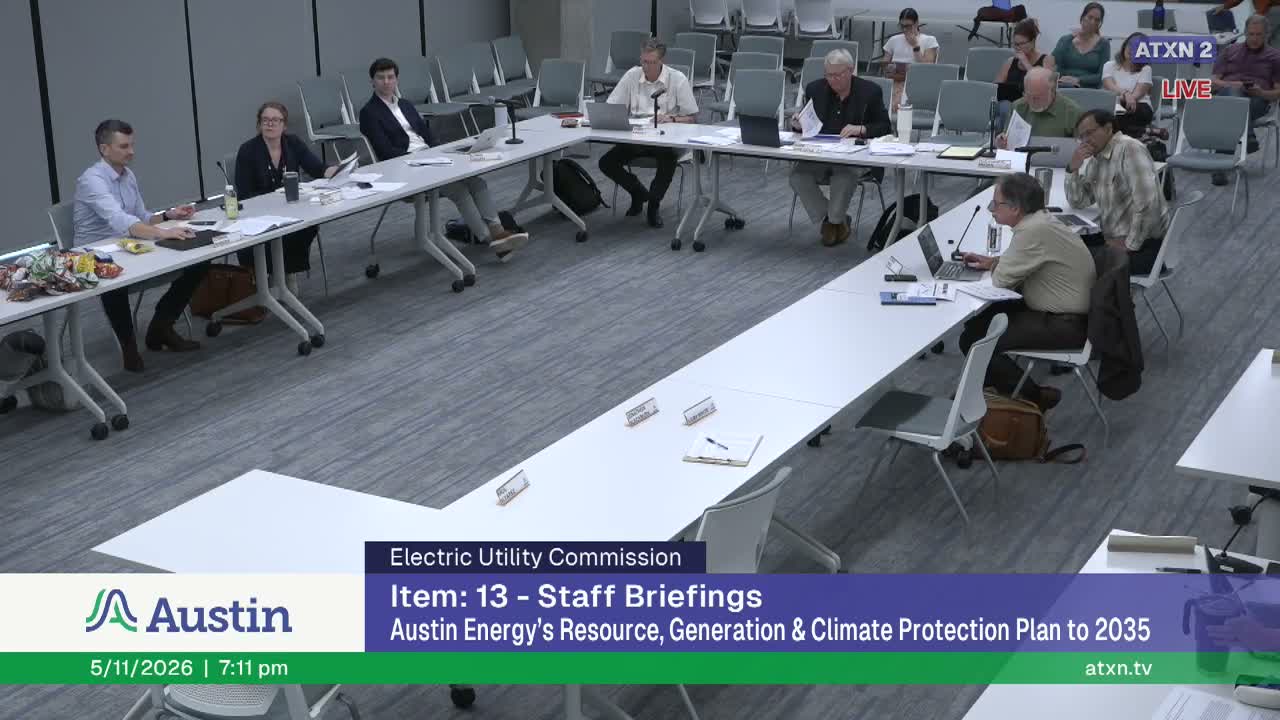
Austin Energy staff told the Electric Utility Commission that its updated modeling shows the city faces rising local reliability and market‑cost risks as demand grows, and that adding about 400 megawatts of efficient natural‑gas peaker capacity would sharply reduce those modeled risks.
Lisa Martin, Austin Energy’s chief operating officer, framed the recommendation as part of the utility’s Resource Generation and Climate Protection Plan to 2035. She said staff modeling projects an average of roughly 575 "reliability risk hours" per year between 2030 and 2035 under the utility’s current portfolio plus newly contracted renewables and batteries; adding modeled peaker capacity reduced that risk to roughly 45 hours per year. Martin said a comparable amount of batteries in place of peakers returned the model to higher risk levels, particularly for longer‑duration events and extreme winter scenarios.
“Peakers are the reliability backstop,” Martin said, adding that the new units would use the latest emission controls, operate under run‑time limitations tied to permits and the plan’s emissions guardrails, and provide black‑start capability other technologies cannot. Staff recommended taking a cautious minimum approach — seeking authority to move toward approximately 400 MW rather than a larger, indefinite buy — and described a procurement path that begins with authorization to negotiate and secure long‑lead equipment followed by competitive contracting for balance‑of‑plant and construction.
Public commenters and several commissioners pushed back. Eileen McGinnis, founder of Parents Climate Community, urged the commission to reject any move that would lock the city into new fossil infrastructure, arguing local health and climate impacts outweigh asserted reliability benefits. Bob Hendricks of the Sierra Club and others asked to see the operating models and assumptions that produced staff’s conclusions; they said the public has a right to the evidence if the city is to approve multi‑hundred‑million‑dollar fossil investments.
Commissioners focused questions on three topics: the duration and frequency of high‑risk events that peakers would address; why staff is pursuing confidential, competitive negotiations for long‑lead equipment rather than a public RFP; and whether transmission upgrades or additional batteries could produce similar benefits. Staff said the all‑resource RFP produced multiple battery offers but no peaker proposals deemed viable; after additional feasibility work the utility concluded the long‑lead equipment path would best protect competitiveness and pricing for ratepayers, with later competitive procurements for construction.
Stuart Riley, Austin Energy general manager, clarified that confidentiality in early negotiations is intended to avoid "price signaling" to vendors and preserve a broad competitive pool; he said the process will be followed by public council approvals and standard competitive solicitations for construction. John Davis, acting CFO, said the initial equipment authorization is not yet included in the FY27 forecast and that the forecast assumes a 5% annual base‑rate increase in its modeling.
Several commissioners asked staff to refresh or disclose modeling assumptions (noting Ascend Analytics performed earlier third‑party analysis for the 2035 plan) and requested a narrow set of additional studies or a third‑party validation before forwarding an authorization to city council. Other commissioners said the modeling and the financial exposure from past extreme events support acting promptly to reduce risk.
Martin and staff reiterated planned mitigations: strict emissions guardrails tied to permits, siting considerations from a 14‑site shortlist, community engagement actions (air filters, landscaping, fire‑department training, local benefits), and commitments to minimize long‑term usage and to prioritize cleaner resources when possible. Linda Reif, who led outreach, summarized public concerns about proximity to schools and vulnerable communities and urged early, transparent engagement and visible local benefits.
The commission did not complete a final vote on item 12 in the excerpted meeting record. Staff said council consideration is scheduled, and that the staff recommendation to seek authorization to negotiate would be presented to council with the balance of supporting analysis and procurement steps.