Get Full Government Meeting Transcripts, Videos, & Alerts Forever!
Get email alerts on the Public Comment Transparency topic
No spam. Unsubscribe anytime.
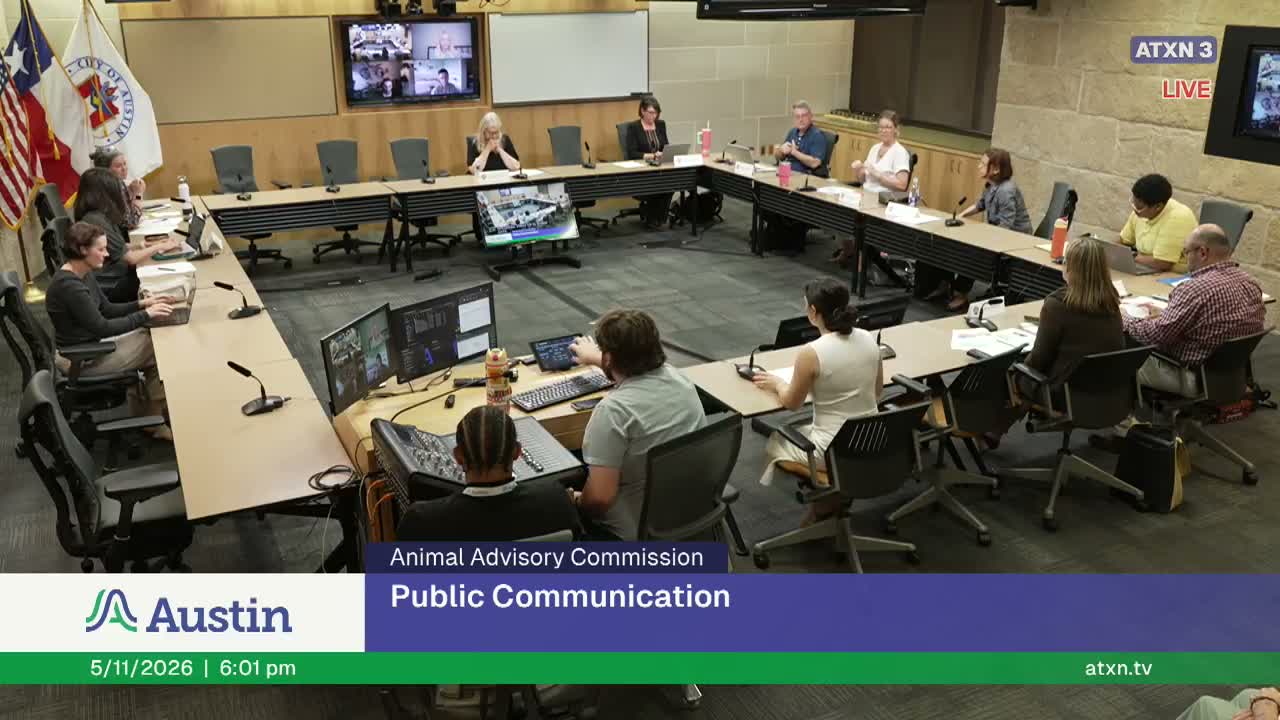
Speakers urge transparency on transfers and 3‑1‑1 responses as commissioners hear public comment
Summary
Public commenters told the commission they see animals left on streets after 3‑1‑1 reports and asked Austin Pets Alive/APA to detail outside‑of‑Austin transfers; speakers recommended better 3‑1‑1 training for cruelty triage and more oversight.
Multiple public speakers used the commission’s public‑comment period to press staff and rescue partners for transparency and better field response.
Robin Katz Gonzales opened public comment with a string of recent incidents she said showed the limits of a strict no‑kill approach. "No kill to me is either less dogs picked up to increase the stats for the shelter or giving dogs away to anybody who has a pulse," she said, describing several animals that were left after 3‑1‑1 calls and, in one case, found deceased the next day. She urged training for animal protection officers and 3‑1‑1 staff and asked the commission to consider adoption screening that includes criminal background checks and lease verification.
A remote caller identifying as Stanford Butler recounted contractual history between the city and Austin Pets Alive (APA) and asked staff—"Miss Dangler"—to report the exact number of animals transferred into Austin from outside the city after hearing counts of 642 animals in March and 680 in April that were described as "transferred in from outside." Butler urged the commission to seek transparency on how many animals are sourced from outside Austin and how that affects local capacity.
Vice Chair Joanne Norton acknowledged the concerns and asked staff about 3‑1‑1 scripts and triage. AAS staff said they meet monthly with 3‑1‑1 and review caller‑scripts; staff said they instruct 3‑1‑1 to avoid telling residents to leave animals at the roadside and to record service requests that can be routed to AAS for follow‑up.
Commissioners and staff agreed commissioners should receive a staff report on transfers and 3‑1‑1 follow‑up protocols at a future meeting to address questions of capacity and consistency in field triage. The commission did not take an enforcement action against APA at the meeting; public commenters asked for a written report on transfer numbers and for staff to follow up on training for call‑takers and animal‑protection officers.