Get Full Government Meeting Transcripts, Videos, & Alerts Forever!
Get email alerts on the Housing And Workforce topic
No spam. Unsubscribe anytime.
Local economic developers stress housing, workforce and licensing fixes as top constraints
Summary
Panelists from Loveland, Fort Collins, Wellington, Estes Park and Larimer County said affordable housing, workforce shortages and complex licensing processes are the chief obstacles to business growth and outlined targeted policy and program responses.
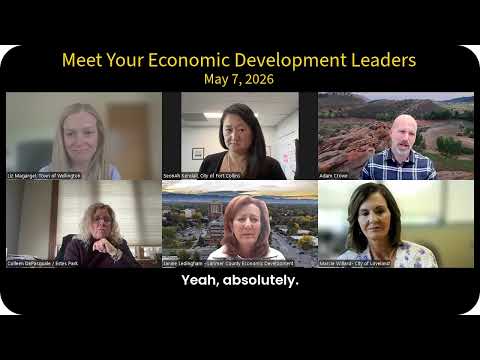
Panel moderator Adam Crow asked local economic developers to identify the single priority they want to accomplish next year and the leading constraints standing in the way.
"Affordable housing is one of the most important and critical issues we have in Northern Colorado," said Marcy Willard, director of economic development for the city of Loveland, who linked housing shortages to workforce gaps and a lower tax base after the city earlier removed a sales tax on food for home consumption.
Panelists described several tactical responses. Willard listed tools under consideration or in use — accessory dwelling units, fast-track development review, small-lot templates and scalable capital-expansion fees — as part of Loveland’s work with a regional affordable-housing task force.
Janine Leadingham, associate director of Larimer County’s economic and workforce development, said the county is working with business-led sector partnerships (manufacturing, construction, hospitality, nonprofit, financial services, health care and a growing bioscience/med-device network) and higher-education partners to create talent pipelines.
Sana Kendall, director of Fort Collins’ economic health office, said her office is pursuing a cultural shift toward being a partner for businesses rather than a gatekeeper, and is leading licensing-process improvements. "If we can accomplish that, I think that's going to be a huge win for our businesses who struggle every day," she said, describing efforts to reduce friction in business licensing and the customer experience.
Other practical challenges noted by panelists included seasonal staffing and housing for tourism-dependent towns such as Estes Park (panelist Colleen DePasquale said Sundance-related visitor demand is driving local planning) and commute times that Wellington hopes to shorten by attracting more primary employers.
Panelists recommended early outreach to municipal and county economic-development staff and highlighted local programs such as utility rebate assessments and business navigators to reduce costs and speed project timelines. The panel closed with organizers sharing links and contact information in the meeting chat for follow-up.