Get Full Government Meeting Transcripts, Videos, & Alerts Forever!
Get email alerts on the Affordable Housing topic
No spam. Unsubscribe anytime.
Macon‑Bibb Affordable Housing Fund commits $1.2 million to five‑home project in South Macon
Summary
The Macon‑Bibb Affordable Housing Fund said it is committing $1.2 million to build five for‑sale homes in a South Macon neighborhood, combining land‑banked lots, local builders and community engagement; county and city officials called the work part of broader efforts to combat blight and stabilize neighborhoods.
Natalie Boyette, executive director of the Macon‑Bibb Affordable Housing Fund, announced at a South Macon event that the Fund is committing $1,200,000 to a five‑home development intended for sale to qualified buyers. "This development of 5 homes … represents $1,200,000 of funding committed from the affordable housing fund," Boyette said, adding that most of the money is expected to return to the fund when the homes are sold and be reinvested in future projects.
Boyette described the Fund’s mission as providing flexible financing to support affordable housing development and to prevent shortages across Macon‑Bibb County. She said the Fund currently holds five active loans with local organizations, naming Infill Housing, Habitat for Humanity and Historic Macon as long‑time partners.
"The Land Bank Authority has been an incredible partner, picking up dozens of lots in this area so that we can start our development work," Boyette said, and she added that the Land Bank has commissioned a neighborhood market study that will coordinate community meetings to identify local needs.
Jerry Battle, introduced as the Macon‑Bibb neighborhood coordinator, said community organizing and ongoing neighborhood cleanups help sustain improvements around new development. "When neighborhoods have a consistent place to come together to share concerns, to plan and support one another, that's when real sustainable progress takes root," Battle said.
Keith Moffett, introduced at the event as county manager for the consolidated Macon‑Bibb government, framed homeownership as a tool for stability and credited partnerships among the county, the Land Bank, the Affordable Housing Fund and private builders for making the project possible. He cited connections to nearby Bruce Elementary School and local community groups, including the 100 Black Men chapter that has supported school programs.
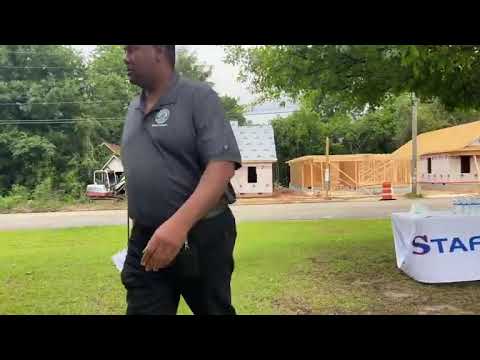
A Stafford Construction representative, introduced by organizers as Keith Stafford, outlined construction specifications and timing: 20‑year‑warranty shingles, durable luxury vinyl tile flooring, local suppliers and appliances provided for each home. "In about three months, these houses will be completed, and they will be ready for the new homeowners," the contractor said, noting that qualified buyers will have options to choose finishes.
Mayor Miller praised the cross‑sector effort and described broader neighborhood gains he said were linked to redevelopment. He said the county’s blight‑fight program had removed "over 150 dangerous structures" in the immediate area and that the neighborhood had seen a "68% drop in violent crime." Those figures were stated at the event by the mayor and were not verified in documents presented on site.
Organizers encouraged resident participation in upcoming community meetings tied to the market study and invited attendees to leave well wishes inside one of the new homes as part of a ceremonial gesture; officials said a ribbon cutting and move‑in events will follow as families take occupancy.
The project combines public‑sector tools (land‑banked lots, tax‑sale and condemnation activity cited by officials) with Fund capital and local contractors. Funding sources beyond the $1.2 million commitment were not specified at the event. Officials said proceeds from the eventual home sales are expected to be recycled into future affordable‑housing work in Macon‑Bibb County.
The event concluded with officials thanking partners, urging continued collaboration and noting that additional outreach and planning steps, including the Land Bank’s market study and community meetings, will follow.