Get Full Government Meeting Transcripts, Videos, & Alerts Forever!
Get email alerts on the Wsbo Funding Staffing topic
No spam. Unsubscribe anytime.
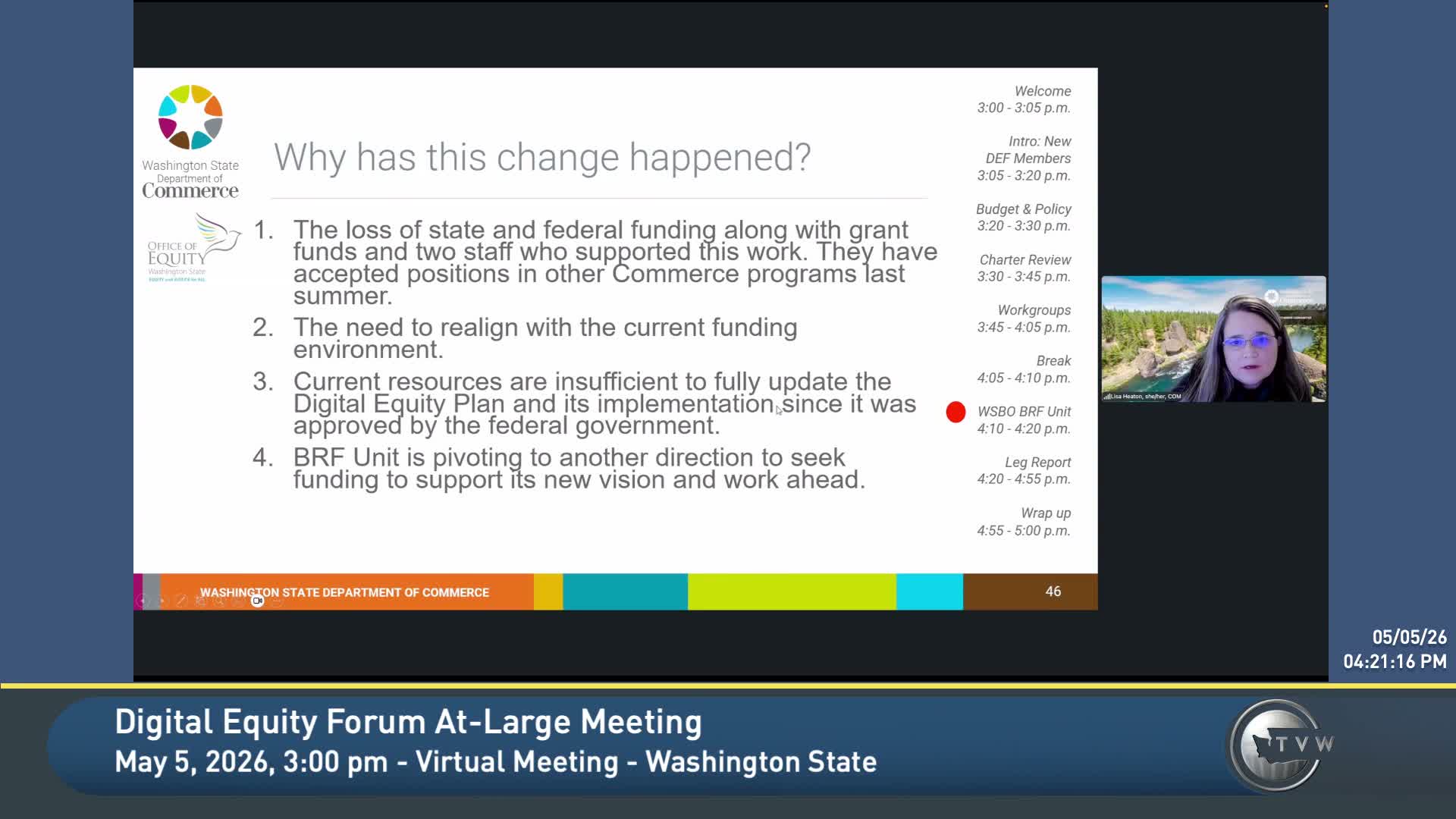
State Broadband Office reports 33% staffing reduction, lost NTIA funding and pivots to a 'Broadband Resilient Futures' unit
Summary
Commerce staff told the Digital Equity Forum that the State Broadband Office lost roughly one‑third of its staffing and $16 million in NTIA capacity grant funds, prompting a reorganization into a Broadband Resilient Futures Unit and a move toward scenario‑based planning and smaller, fundable roadmap projects.
At the May 5 meeting of the Digital Equity Forum, Washington State Broadband Office staff outlined staffing losses and a funding shortfall that are reshaping the office's approach to digital‑equity work.
Lisa Heaton said the Broadband Office lost roughly one third of its staff after state and federal funding changes and described the office’s previous NTIA digital equity capacity grant awards as “nearly $16,000,000 for that work, from fiscal year 2022 to 2024.” Heaton said additional NTIA funding that had been anticipated — “potentially another $10,660,000” — did not materialize, and together those figures represent a cited funding potential of about $26,600,000 that the office can no longer assume for implementation.
Because of the reduced resources, staff announced a pivot: the Broadband Resilient Futures Unit will use scenario‑based foresight planning to prioritize smaller, fundable components of the digital equity plan rather than attempting immediate full implementation. Jonas Green, the unit’s tribal engagement manager, said the unit will coordinate internally with Commerce leadership and the governor’s office and will reach out to DEF work groups for input on roadmap components.
Staff flagged program costs and previous studies as context: the office said the Washington Institute for Public Policy received an appropriation (cited at about $119,000) to study funding models, and that developing the statewide digital equity plan cost more than $1,000,000. Staff also said they will begin voluntary outreach to Internet service providers to collect low‑cost plan information for a public inventory.
Why it matters: Funding and staffing reductions narrow the office’s immediate implementation options and increase reliance on partnerships, outside funding and phased, scenario‑driven delivery of roadmap components.
Next steps: Staff will post the report‑development guide and set up Box folders for work groups, pursue voluntary ISP outreach to collect low‑cost plan information, and solicit work‑group outlines in mid‑July to help prioritize projects for the coming budget cycle.