Get Full Government Meeting Transcripts, Videos, & Alerts Forever!
Get email alerts on the Digital Equity Recommendations topic
No spam. Unsubscribe anytime.
Digital Equity Forum introduces nine new members and lays out seven policy recommendations for agency consideration
Summary
At its May 5 meeting, the Washington State Digital Equity Forum introduced nine newly appointed members and reviewed seven recommendations for Commerce decision packages, urging cross-agency coordination, public–private partnerships, targeted funding models and alignment with poverty-reduction efforts.
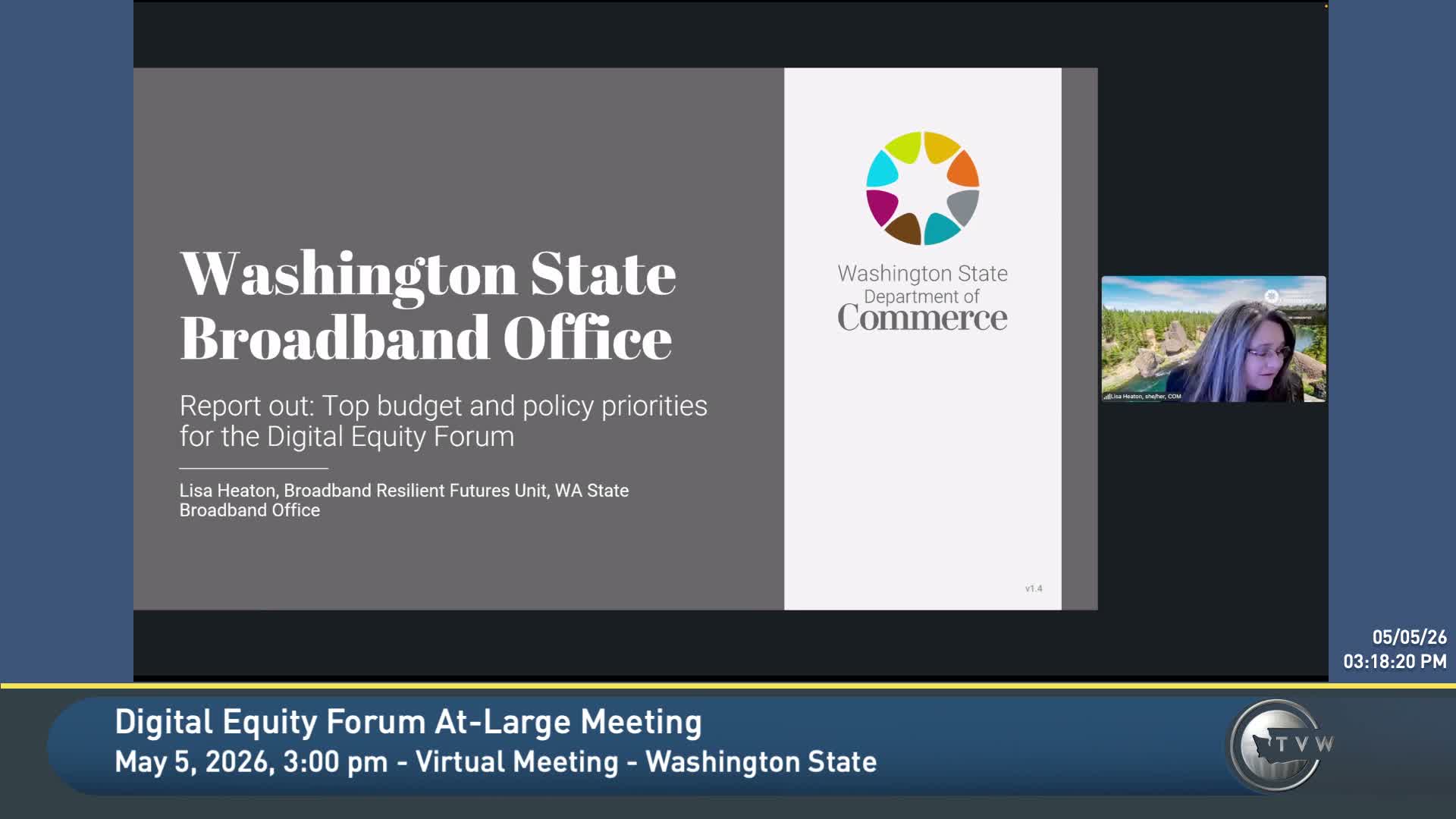
The Washington State Digital Equity Forum on May 5 welcomed nine newly appointed members and heard staff present seven draft recommendations the Forum asked Commerce to consider for agency decision packages and legislative requests.
Lisa Heaton of the State Broadband Office opened the meeting and framed the recommendations as inputs the office will consider during division development and Commerce-level review. “These decision packages are agency proposals…to make a compelling and persuasive argument as to why funding is needed to solve a particular issue,” Heaton said, describing the internal timeline that runs from division development through Office of Financial Management review and the governor’s budget release.
The Forum heard brief introductions from new members, including Michelle Gladstone Wade, director of economic development at the Affiliated Tribes of Northwest Indians Economic Development Corporation, who said she will bring tribal–state economic development experience to the group. Brian Carlson, head of IT for Seattle-based Mary’s Place, and Steve Carson, owner of ComputerLink Northwest, also described the lived and operational experience they will contribute.
Casey Merchant, representing the Office of the Superintendent of Public Instruction, described Recommendation 2: “The ask is to incentivize early interagency conversations so agencies can support each other's shared goals rather than duplicating efforts,” Merchant said, urging a systemic, cross-agency framework to reduce siloed funding and align services for K–12, reentry populations and other groups.
Other recommendations presented by staff included: 1) creating a permanent funding framework to address affordability (for example, examining device or excise taxes and models used in other states); 2) leveraging public–private partnerships to incentivize low‑cost plans and include industry decision-makers in discussions; 3) identifying economic development partners to strengthen local capacity; 4) using cost‑benefit approaches (noting a Legislature-funded Washington Institute for Public Policy study); 5) pursuing national philanthropic or programmatic funders; and 6) aligning digital‑equity work with established poverty‑reduction efforts to avoid duplicative efforts and amplify existing initiatives.
Will Booth, who participated in the partner‑engagement discussions, said bringing industry representatives directly into Forum conversations can shorten implementation timelines: “Having some folks who are in the industry on the DEF where we can get that insight will…make our pathways much clearer,” he said.
Why it matters: Forum members and staff framed these recommendations as inputs into Commerce’s internal prioritization; staff warned that not all ideas will be selected for funding or agency requests because of competing statewide priorities.
Next steps: Commerce staff said they will continue internal work on the recommendations, and — if any ideas are selected for formal decision packages — will share them with the Forum for comment before the governor’s budget process.