Get Full Government Meeting Transcripts, Videos, & Alerts Forever!
Get email alerts on the Noxious Weeds Enforcement And Funding topic
No spam. Unsubscribe anytime.
Counties, DNRC and weed control groups press for clearer enforcement, funding and permit‑level plans
Summary
Council members and county coordinators told the Environmental Quality Council that enforcement gaps and uneven county practices limit progress on noxious weeds; the Montana Weed Control Association urged requiring noxious‑weed management and revegetation plans in permitting, stronger embargo authority for contaminated materials, and more hard funding for EDRR and biocontrol.
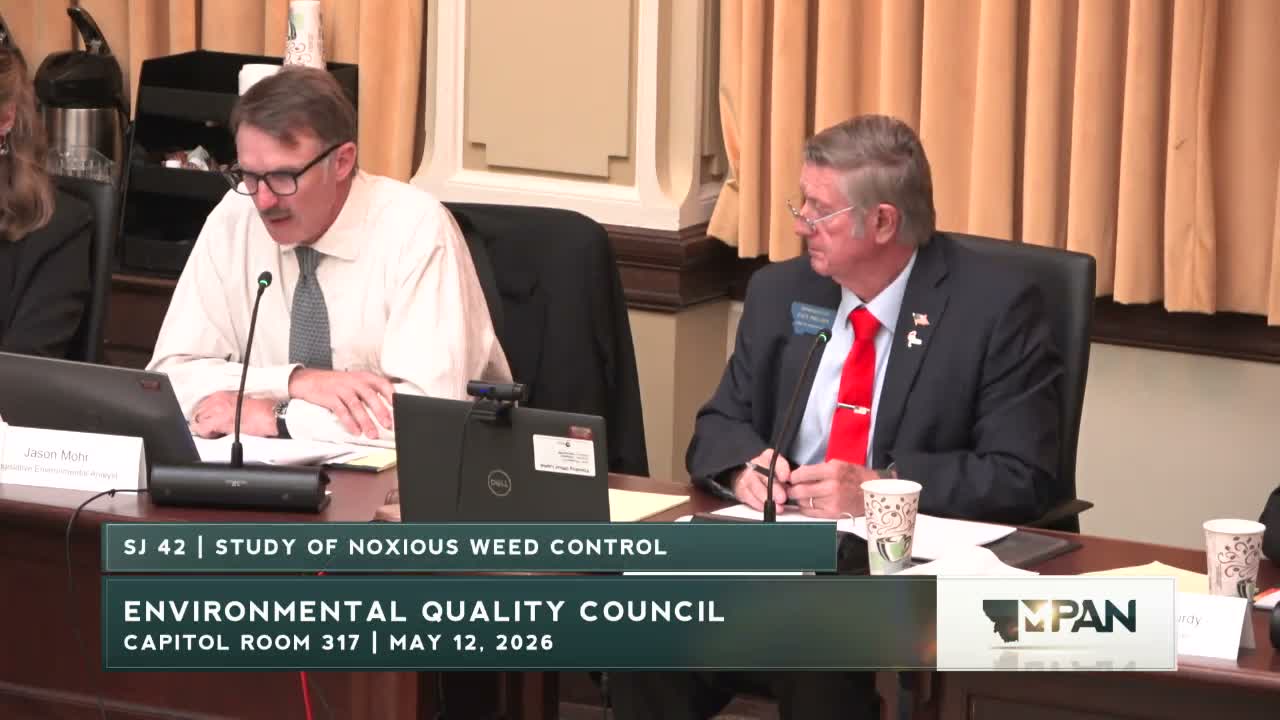
The council’s interim study on noxious‑weed control drew robust discussion from county coordinators, the Department of Natural Resources and Conservation and the Montana Weed Control Association about enforcement, funding and permit‑level prevention.
Staff summarized draft findings and legislative history going back to the County Weed Act of 1939, noting key statutory changes that made districts countywide, adjusted the mill‑levy floor and rewrote compliance procedures. Jason Moore told members the compliance framework and funding floor have been persistent issues in testimony across meetings.
Parker Osterlow, DNRC land section supervisor, described how trust‑land management works in practice: DNRC manages about "5,100,000 surface acres of trust land" and leases about 93% of it; DNRC’s direct weed expenditures average about $222,000 a year (including one FTE), and the department inspects roughly 1,300 tracts annually during lease renewal cycles (about 500,000 acres) and can require lease stipulations or reduced terms for chronic mismanagement.
Becky Kington, executive director of the Montana Weed Control Association, told the council that ‘‘noncompliance has been identified with our weed districts across the state as the number 1 concern.’’ The association urged that noxious‑weed management and revegetation plans be required as part of permitting for activities that commonly spread seed (gravel pits, solar and wind construction, tower installs and subdivisions), rather than relying on a 15‑day notice that does not ensure follow‑through. The association also pressed for more hard funding for the noxious weed trust fund’s programs (EDRR, biocontrol, education and research) and asked for consistent embargo authority so boards can halt movement of contaminated forage and aggregates.
County coordinators and association leaders flagged enforcement practicalities: current law requires a complaint‑driven noncompliance process with notices, hearings and, ultimately, county‑attorney action; counties vary in whether and how they pursue civil penalties (statute and local practice leave wide discretion). A county coordinator explained that the current penalty cap for a board assessment is 25% of the treatment cost, and that the full noncompliance procedure (inspections, notice, appeal, prosecutorial review) places a heavy administrative and legal burden on local boards.
Council direction: members asked staff to work with the Weed Control Association to draft clearer statutory language and possible legislative options that address noncompliance, permit review timing, escrow or bonding for mitigation on major developments, and embargo procedures, with the goal of returning specific proposals for consideration.
What was not done: the council did not adopt or vote on any specific changes; members requested more worked‑through statutory language from staff and stakeholders before drafting bills.
Next steps: staff (Jason Moore) was directed to collaborate with weed stakeholders to translate the association’s recommendations into draft statutory language and options for the council’s administrative session and future meetings.