Get Full Government Meeting Transcripts, Videos, & Alerts Forever!
Get email alerts on the Juvenile Assessment Center topic
No spam. Unsubscribe anytime.
Douglas County assessment center recommends diversion for most youth, director says
Summary
Shawn Johnson, director of the Douglas County Juvenile Assessment Center, told a county webinar that JACC uses evidence-based screening to recommend informal diversion for about 30% of assessed youth, formal diversion for about 65%, and court supervision for roughly 5%; trauma and behavioral-health needs remain high.
Shawn Johnson, director of the Douglas County Juvenile Assessment Center, said at a May webinar that the centerassesses youth referred by the county attorney and aims to divert eligible young people from formal court processing.
Johnson described the JACC as a neutral, evidence-based screening and assessment hub that provides recommendations to the county attorney and recommends interventions to reduce reoffending. "We do strive to divert all eligible youth from formal processing," Johnson said.
Why this matters: The juvenile assessment center is the county-level intake point for many youth with law violations and its screening decisions shape whether a young person faces court supervision or receives diversionary services such as counseling, restorative programs or life-skills classes.
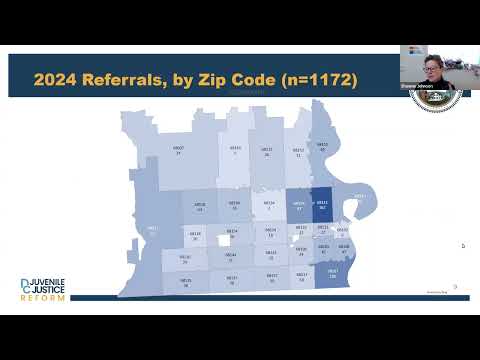
According to Johnson, JACC uses validated instruments (including the MASI-2 behavioral-health screen) and a risk-need-responsivity framework to match service intensity to assessed criminogenic need. He said 2024 snapshot figures show 1,172 youth were referred to the center while 90 were assessed that year; some referred families decline the voluntary assessment, some youth leave the jurisdiction, and some pick up new charges and become detained before assessment.
Johnson identified key screening findings: 58% of referred youth were male and most were 14 to 17 years old; many youth show high trauma exposure and elevated behavioral-health needs. He cautioned that the suicide-ideation item on the screener captures thoughts in the prior three months and therefore reads low, but broader interview questioning covering a year finds "our suicide ideation ... is around 20 percent," he said.
On outcomes, Johnson explained JACC recommendations typically fall into three buckets: immediate informal diversion (yellow) for low-risk youth, formal diversion case plans (gray) for moderate/high risk, and court supervision for a small share of very high-risk cases. He summarized the rough distribution: about 30% informal diversion, about 65% formal diversion plans, and about 5% recommended for court supervision because of risk or community-safety concerns.
The center refers youth to a wide array of community providers for counseling, decision-making classes, gender-based groups, wraparound services, restorative justice and mentoring; Johnson listed local partners but did not name every provider.
Johnson also noted operational improvements, saying JACC recently sought funding to expand staff, which shortened caseloads and timelines and allowed quicker contact and follow-up with assessed youth. He added the center has implemented staff-support trauma practices (TCare) and is rolling out a trauma screen for youth to better target behavioral-health referrals.
The webinar recording will be posted on the Douglas County juvenile justice reform page and emailed to registrants; the session moderator said the series will continue with a follow-up session next month.