Get Full Government Meeting Transcripts, Videos, & Alerts Forever!
Get email alerts on the Education Deregulation topic
No spam. Unsubscribe anytime.
Senate committee advances broad education deregulation bill after heated testimony on teacher hours and AED language
Summary
House Bill 1,004, a sweeping cleanup of K‑12 statutes that removes outdated mandates and reporting requirements, was amended and advanced after hours of testimony; supporters praised deregulation while unions and teachers’ groups pushed to restore protections on teachers’ expected hours and joint program safeguards.
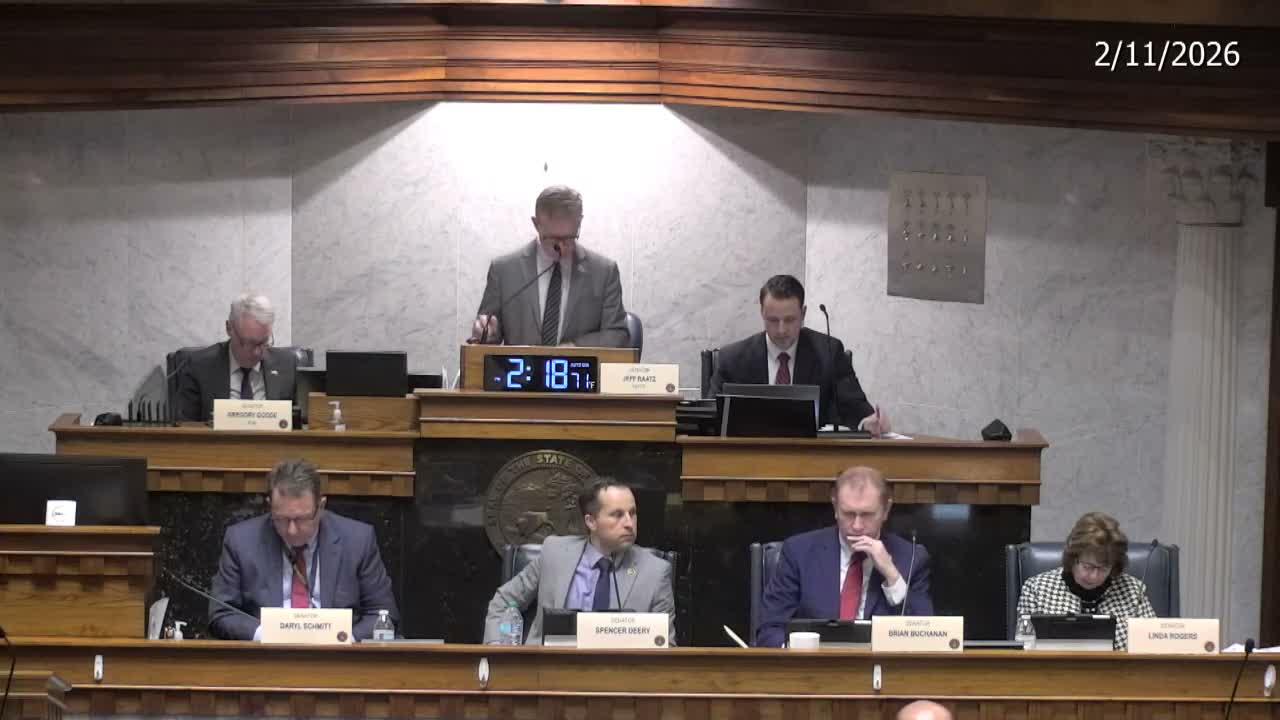
The Senate Education and Career Development Committee advanced House Bill 1,004 on Feb. 11 after extensive debate on deregulatory changes to Indiana’s K‑12 code.
Representative Colin Behning, the bill author, told the committee the measure removes roughly 17,000 words of stale or duplicative code and includes changes to reporting, facilities language, teacher contract provisions and other items. "Everything seems to be a priority — if everything is a priority, nothing is a priority," Behning said, framing the bill as an effort to reduce administrative burden.
Testimony split along stakeholder lines. The Institute for Quality Education and charter advocates supported the bill as a modernization and simplification of the code. Julie West, founder of Play for Jake Foundation and a parent who lost a child to sudden cardiac arrest, urged retention of school AED and cardiac response planning language (amendment No. 6), saying the policy can save lives.
Unions and teachers’ groups pressed for restoring protections on teacher contract language that specifies expected work hours. Joel Hand of the American Federation of Teachers‑Indiana said the hourly expectation in individual contracts provides teachers with reasonable work expectations and protections against abuses. Gail Zaharolis of the Indiana State Teachers Association warned the removal could destabilize recruitment and retention: "If we remove these hours expectations, the question becomes: when does it end?" she said, noting a prior court finding that certain forms were unconscionable when they allowed unilateral administrative changes without compensation.
Committee members offered and voted on multiple amendments addressing adjunct teacher reporting, hours language, reporting on remediation spending, and AED/cardiac response requirements. Amendment votes were mixed: several amendments aimed at restoring protections failed in committee, while language ensuring AEDs and cardiac response plans remained in the bill gathered support during the hearing. Representative Behning and supporters said funding remains available for some programs and that the bill sought to eliminate mandates rather than prohibit local action.
After debate and testimony from superintendents, principals and advocacy groups, the committee voted to recommit the bill to appropriations as amended; the chair announced the bill "passes as amended 8 to 4" in committee. Sponsors said they will consider second‑reading amendments for some contested items.
What happens next: The committee recommitted HB 1,004 to appropriations; sponsors said they expect additional amendments on the Senate floor and in appropriations, particularly on teacher‑hours language and protections for joint program teachers.