Get Full Government Meeting Transcripts, Videos, & Alerts Forever!
Get email alerts on the Ips Governance Ipec topic
No spam. Unsubscribe anytime.
Senate committee backs shift of IPS facilities, transportation to IPEC after heated debate
Summary
After extended debate and failed amendments addressing board composition, referendum funds and local control, the Senate Education and Career Development Committee advanced House Bill 14‑23 to move Indianapolis Public Schools’ facilities and transportation oversight to the Indianapolis Public Education Corporation (IPEC); the measure passed 9–4 in committee.
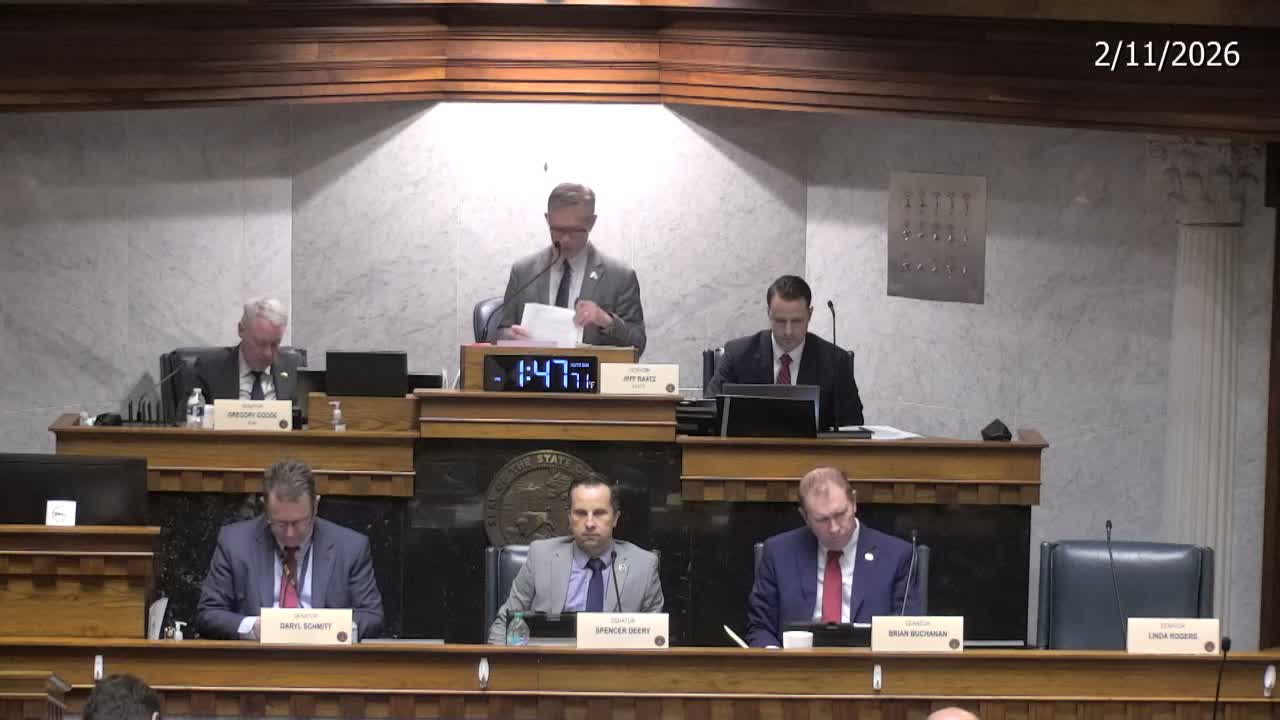
The Senate Education and Career Development Committee voted 9–4 on Feb. 11 to pass House Bill 14‑23 as amended, advancing a plan to transfer oversight of Indianapolis Public Schools’ (IPS) facilities and transportation to the Indianapolis Public Education Corporation (IPEC).
Representative Colin Behning, the bill’s House sponsor, told the committee the measure narrows earlier language to exclude adult and virtual charters, shortens board terms to four years to comply with constitutional limits, and clarifies which charter‑related appointees may sit on the IPEC board. "When the bill left the House, we had 6 year terms. We found out the constitution strictly prohibits ... terms more than 4 years," Behning said in explanation.
Opponents framed the bill as a removal of local control. Senator (transcript: FADI KADURA) argued the change would amount to "taxation without representation," urging the committee to require a local ballot initiative before converting an elected school board into an appointed entity. "You can't have an elected board asking people to raise taxes and then shift the dollars to an appointed board," the senator said.
The committee considered multiple substantive amendments seeking to: send the bill to a summer study committee (amendment No. 18), impose a five‑year moratorium on any new schools within IPS (amendment No. 19), require a two‑thirds local ballot approval before conversion (amendment No. 20), and change the proposed composition of the IPEC board to increase elected IPS representation (amendment No. 26). Most of those amendments failed on roll calls, while a technical amendment addressing charter contracts and referendum flow was adopted.
Representative Behning explained a key financing point: referendum dollars raised and approved by IPS would be routed to IPEC after the transition and, if IPEC issues bonds, the debt would be issued by IPEC not IPS. "If IPEC issues, IPEC would be issuing the bonds. It would not be IPS," Behning said.
Supporters argued IPEC is intended to address unique governance and facilities issues in Indianapolis, where a large share of students attend schools outside IPS boundaries; backers also said the change would not remove IPS’s control over general fund spending for education. Opponents warned the shift could politicize mayoral races and concentrate power, increase outside spending, and set a precedent for altering governance in other districts.
The committee’s floor exchange recorded several senators offering "explain my vote" statements before the final tally. After debate, the chair announced, "Bill passes as amended, 9 to 4." The committee recommitted the bill to appropriations for further consideration.
What happens next: The bill moves to appropriations under a recommit; additional adjustments and second‑reading amendments are possible as the measure proceeds through the Senate.