Get Full Government Meeting Transcripts, Videos, & Alerts Forever!
Get email alerts on the Housing Transit Sb79 topic
No spam. Unsubscribe anytime.
Milpitas Planning Commission recommends ordinance to implement SB 79 near transit
Summary
The Planning Commission voted unanimously April 22 to recommend a zoning text and map amendment creating a Transit-Oriented Development (TOD) overlay to implement the state’s SB79 near three major transit stations; staff proposed a 40-dwelling-unit-per-acre minimum and said projects must meet objective R4 Metro standards and affordability rules.
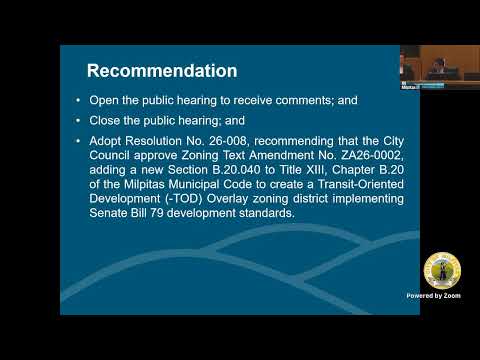
On April 22, 2026, the Milpitas Planning Commission voted unanimously to recommend that the City Council adopt a zoning text and map amendment creating a Transit-Oriented Development (TOD) overlay to implement the state Abundant and Affordable Homes Near Transit Act (Senate Bill 79).
Principal Planner Lillian Van Hois told the commission the ordinance is intended to give the city local direction where SB79 is otherwise silent. "SB79 takes effect July 1, 2026, and it significantly limits local discretion over land use near transit," Van Hois said, explaining that, without a local ordinance, qualifying projects on commercially zoned land could be subject only to the state’s baseline standards.
The proposed overlay would apply to properties within a half mile of the city’s three major transit stops (the Milpitas BART station and two VTA light-rail stations) and would set a local minimum density of 40 dwelling units per acre in the overlay while requiring projects to follow the R4 Metro zoning-district development standards. Van Hois said the change is intended to help the city meet its regional housing needs allocation and local housing-production goals.
Van Hois summarized project eligibility and standards under SB79 as staff understands them: projects must include at least five dwelling units; average unit size must not exceed 1,750 net habitable square feet; projects over 85 feet in height must meet state labor standards; and sites where rent-controlled housing was demolished within the last seven years are ineligible. She also outlined on-site affordability options for projects larger than 10 units: at least 7% extremely low income, 10% very low income, or 13% lower income, with rental affordability terms of 55 years and ownership terms of 45 years.
Commissioners asked detailed questions about how the overlay would interact with existing specific plans and whether developers could choose between existing Metro-plan allowances and the new overlay. Van Hois said where zoning already permits higher intensity—examples cited include areas that allow up to 250 dwelling units per acre and building heights up to 275 feet near the BART station—developers may not need to invoke SB79.
Vice Chair Kong pressed staff on whether industrially zoned lands are included; a commissioner also expressed concern about protecting employment lands near transit. The city attorney (recorded in the transcript as Attorney Gree) responded that the draft ordinance tracks SB79’s scope and, as drafted, excludes industrial zones. "The ordinance only applies to properties zoned for residential, mixed use, or commercial," the attorney said, while noting the commission could revisit the ordinance language in the future if needed.
Commissioners also asked whether the city had performed a new infrastructure-capacity analysis for traffic, schools or utilities. Van Hois said the city had not conducted a new citywide analysis tied to SB79 and that project-level environmental review and technical studies would be done on a case-by-case basis; she cautioned that projects proposed outside previously studied plan areas may require additional analysis.
During public comment, Triana Grayton, a senior transportation planner with VTA and a Milpitas resident, spoke in support of the ordinance and offered VTA’s technical assistance. "We believe SB79 can play an important role in creating more vibrant, complete communities around the rail stations," Grayton said, while noting implementation is complex and VTA is available as a partner.
A motion to adopt Resolution 26-00008 (recommending City Council approval of zoning text amendment ZA26-00002 to add the TOD overlay implementing SB79) was made, seconded and approved by roll call. Miss Le recorded the following votes: Commissioner Castillo — yes; Commissioner Kulkins — yes; Commissioner Awasti — yes; Commissioner Galong — yes; Vice Chair Kong — yes; Chair Gupta — yes. The commission voted to forward the recommendation to the City Council.
The commission scheduled no immediate follow-up action on the ordinance itself; staff noted a special Planning Commission meeting on May 6 at 6:00 p.m. The recommendation will go to the City Council for consideration under the city’s regular legislative process.