Get Full Government Meeting Transcripts, Videos, & Alerts Forever!
Get email alerts on the Health And Human Services Budget topic
No spam. Unsubscribe anytime.
Senate Finance advances health-and-human-services supplemental with hospital, pharmacy and food-aid increases; IVF coverage added for private group market
Summary
The Senate Finance Committee advanced Senate File 4612 with voice votes on multiple amendments, adding hospital stabilization funding, a temporary $2.25 pharmacy dispensing fee, expanded food-shelf funding and a childcare-licensing update; an amendment to extend infertility (IVF) coverage to the private group market (excluding SEGIP and Medical Assistance) was carried forward and adopted. The bill was recommended to pass as amended.
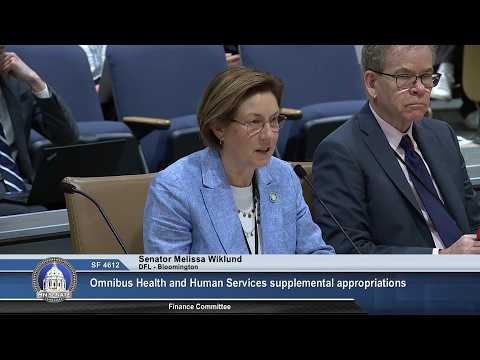
Sen. Julie Wiklund, chairing the Health and Human Services portion of the Senate Finance Committee, presented Senate File 4612 on April 23 as a supplemental budget package aimed at "protecting Minnesotans' health, stability and dignity during a time of serious uncertainty," and said most of the bill responds to federal changes referred to in the hearing as HR1.
The omnibus proposal includes funding and technical fixes across the Department of Human Services, Department of Children, Youth and Families, Department of Health and related agencies. Fiscal staff summarized the committee spreadsheet and said the Senate plan totals roughly $8.1 billion in the first biennium on the lines reviewed in committee. Key elements adopted in committee included expanded hospital stabilization provisions, a temporary pharmacy dispensing fee and increased grants for food-support programs.
The committee approved the author's A39 amendment after a page-and-line walkthrough by Senate counsel Aly Hoffman Litchy. The amendment clarified targeted case-management language, increased the number of covered physical therapy visits for certain children after surgery (Sen. Wiklund cited a fiscal note estimating roughly $37,000 in first-year costs for that change), adjusted hospital-stabilization definitions and reporting, and aligned several technical appropriation changes with the spreadsheet. After brief questions, members adopted the amendment by voice vote.
Mr. Vesel, the committee fiscal analyst, then walked members through the spreadsheet in detail, explaining the Senate's choices on HR1-related eligibility and administrative changes. He noted that the Senate did not pick up all of the governor's HR1 proposals (for example, the Senate did not adopt the governor's proposed limits on retroactive Medicaid eligibility). The fiscal review also described a $2.25 interim pharmacy dispensing fee while waiting for federal approval and an estimated $7.3 million first-biennium cost for that item.
The bill includes increased state support for food-assistance programs: committee discussion and the spreadsheet referenced increases for food-shelf grants and prepared meals programs (committee materials cited figures including $5.4 million for food shelf grants and $2.5 million for prepared meals; Sen. Wiklund earlier referenced raising the food bank program by $5 million and the food shelf program by $2.8 million in related provisions).
Department of Health Commissioner Brooks Cunningham addressed the committee, expressing appreciation for the bill and raising a specific concern about submerged closed-loop heat exchanger language. Cunningham said variances that rely on third-party reviews may not be fully independent and urged safeguards to protect drinking water and natural resources while supporting appropriate innovation.
The committee considered and adopted multiple other amendments by voice vote: - A40: directs DCYF to develop a licensing framework for crisis nurseries with four pathways and staffing standards (adopted). - An amendment transferring certain HMO regulatory oversight language to the Department of Commerce (adopted). - A42: authorizes MDH rulemaking related to construction wells for helium deposits and related regulatory work (adopted).
A35 (the infertility/IVF coverage amendment) drew extended discussion. Sen. Erin Maye Quade, who presented the amendment, said it would expand infertility-treatment coverage to the group market but would exclude SEGIP (the state employee group insurance plan) and Medical Assistance, and that stakeholders agreed the step should proceed this session given budget constraints. Members raised questions about jurisdictional fit (Commerce versus Health committee work), the fiscal impact on employers and premiums, and clinical/ethical questions raised by Sen. Howe about embryo ownership and implantation consent. Maye Quade and other senators said other states (she cited Colorado, Washington and Oregon) have similar mandates and that available evidence from other states does not show substantial impacts on premiums in large-group markets. The committee debated laying the amendment on the table while seeking additional cost information; discussion proceeded and the amendment was ultimately adopted by voice vote in committee after members resolved to pursue further review where necessary.
After adopting the amendments and instructing staff to make technical and conforming changes, Sen. Wiklund moved Senate File 4612 as amended to be recommended to pass; the committee approved the motion by voice vote and adjourned. Committee members were reminded of upcoming business and a reconvening time.
Votes at a glance (voice votes taken in committee): A39 (author's amendment) — adopted; A40 (crisis-nursery licensing) — adopted; HMO oversight transfer amendment — adopted; A35 (IVF/infertility coverage to private group market, excluding SEGIP/MA) — discussed and adopted by committee; A42 (helium rulemaking) — adopted; SF 4612 as amended — recommended to pass.
Why it matters: Committee members said the supplemental bill is designed to blunt federal policy-driven disruptions (referred to in the hearing as HR1) to Medicaid, SNAP and other supports; the package combines immediate stabilization funding, technical fixes and programmatic changes intended to preserve access to care and prevent larger costs for counties and hospitals.
What’s next: The committee recommended the bill to pass; staff were instructed to make technical and conforming edits before floor consideration.