Get Full Government Meeting Transcripts, Videos, & Alerts Forever!
Get email alerts on the Wildfire Preparedness topic
No spam. Unsubscribe anytime.
Bakersfield fire officials urge homeowners to create plans, clear defensible space and sign up for Ready Kern
Summary
On a City of Bakersfield podcast, fire leaders advised residents to rehearse family escape plans, maintain smoke alarms, create 10–100 ft of defensible space where appropriate, assemble go-bags, learn compression-only CPR and enroll in Ready Kern alerts to improve survival odds in fires or quakes.
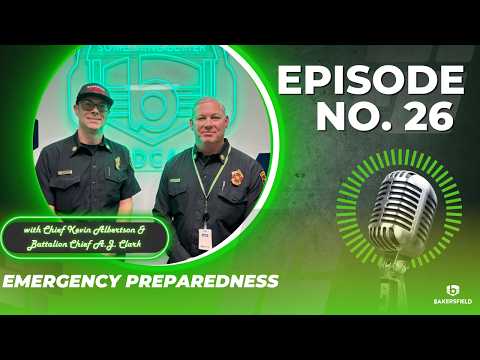
Joe Conroy, public information officer for the City of Bakersfield, hosted a city podcast discussion on household preparedness on May 13, featuring Chief Kevin Albertson and PIO AJ Clark of the Bakersfield Fire Department.
The officials front‑loaded practical steps residents can take to reduce risk and speed emergency response. “I'm Joe Conroy, the public information officer for the City of Bakersfield,” Conroy opened; fire officials then urged listeners to make a written family plan, identify an outside meeting place and rehearse escape drills so people know what to do in the middle of the night.
Why it matters: Wildfires and earthquakes can overwhelm first responders and damage broad areas at once, the speakers said. Fire officials said clearing flammable materials close to a home—removing weeds, stacked wood, cardboard and debris—is one of the most effective ways homeowners can limit ember ignitions and give crews time to protect structures.
Practical guidance offered
- Family plan and drills: Officials recommended households know how to shut off gas, electric and water, pick at least one outside meeting spot and practice escape routes regularly; households with children should rehearse more frequently.
- Smoke alarms and basics: The department urged testing smoke alarms and replacing batteries at the twice‑yearly clock changes as an easy, high‑impact habit.
- Defensible space: AJ Clark explained that the department recommends keeping the first 10 feet around a structure clear of flammable material and aiming for up to 100 feet of defensible space where homes meet wild grass or the wildland‑urban interface. “We always say it's 100ft of defensible space,” Clark said, framing the department’s standard for higher‑risk lots.
- Clearance by flame length: Fire staff offered a rule of thumb for actively burning grass—maintain about 1.5 times the flame length as a buffer (for example, roughly six feet clearance for two‑foot grass) to reduce the chance of direct flame contact with structures.
- CPR: The department encouraged CPR training and highlighted that compression‑only CPR—about 100 compressions per minute—has improved bystander survival outcomes and is easier for most people to perform.
- Earthquakes and go‑bags: For quakes, officials recommended the familiar “drop, cover and hold” guidance (shelter under sturdy furniture when safe) and urged residents to prepare go‑bags with medications, documents, food, flashlights and batteries in case communications and services are disrupted. They also advised establishing multiple meeting locations because cell networks can be overloaded or compromised.
- Alerts and mutual aid: Residents were directed to sign up for Ready Kern alerts for evacuation and hazard notifications. Chief Kevin Albertson noted Bakersfield is part of regional response systems and “has a type one USAR regional task force that specializes in that type of response,” describing how California’s mutual‑aid typing lets incident commanders request standardized engines, rescue teams and support resources when incidents escalate.
Enforcement and support
Officials said the city publishes maps showing where properties sit in higher WUI risk zones and that, under state requirements, the city notifies homeowners when clearing vegetation is required. If homeowners do not comply, the city may arrange cleanup and bill property owners for the work.
What officials emphasize: Rehearsed plans, functioning smoke alarms and neighborhood checks can reduce the number of emergency calls and allow firefighters to prioritize life‑safety rescues. Conroy closed the program by urging listeners to prepare and sign up for alerts.
Next steps: The podcast concluded with a reminder to check batteries during time changes, clear flammable materials from yards, consider CPR training and register for Ready Kern to receive evacuation notices.