Get Full Government Meeting Transcripts, Videos, & Alerts Forever!
Get email alerts on the Unified Development Code topic
No spam. Unsubscribe anytime.
Planner outlines unified development code; council debate centers on accessory dwelling units, RV parking and tree rules
Summary
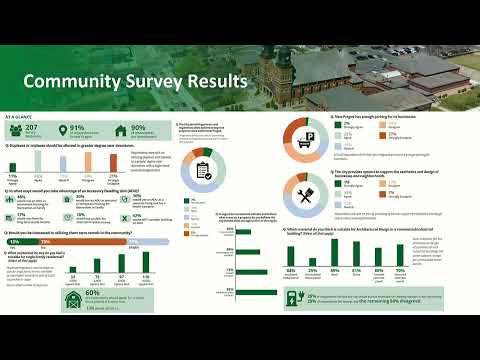
Bolton & Mink planner Jeff Matsky walked New Prague council and planning commissioners through a draft unified development code that consolidates zoning and subdivision rules, incorporating survey input (207 responses). Key debates focused on accessory dwelling units, front-yard/RV parking rules, tree-preservation thresholds and design incentives.
Jeff Matsky, community planning project manager with Bolton & Mink, presented a draft unified development code to a joint session of the New Prague City Council and Planning Commission, saying the rewrite combines zoning and subdivision rules into a single, more user‑friendly document and adds visual guides and incentive-based design options.
Matsky told the meeting the consultant team began work in late 2024 and has produced multiple drafts and public outreach tools, including a survey that yielded 207 responses. "One of the hardest things...is when you get that call it's 'I can't find this in your code' — it's easier when you put something on a website,'" Matsky said, urging clearer charts and graphics to help residents and staff navigate the code.
The draft includes a consolidated use chart (permitted/conditional/accessory) and a dimensional-standards chart (setbacks, height, impervious surface) intended as quick-reference guides for applicants, surveyors and staff. Matsky said those charts will be clearer in the written code and can be posted as handouts online for the public.
A sustained portion of the discussion centered on accessory dwelling units (ADUs). Matsky said the draft includes language to limit ADUs from being used primarily as short‑term rentals or as separate fee‑for‑service rentals, including owner‑occupancy and plumbing/service rules intended to keep ADUs subordinate to a primary dwelling. "One of the conditions we laid out there was either the home or the ADU that is on one property has to be owner occupied — one or the other," Matsky said. Council members pressed for additional safeguards and enforcement mechanisms, citing concerns about group‑home conversions and nonprofit or church uses that could change neighborhood character. Matsky noted state law and evolving state discussions on ADUs could affect local choices, but said the state had not yet imposed a mandate.
On parking and recreational-vehicle storage, the draft would require driveway/paved surfaces rather than front‑yard grass storage; staff said existing gravel or lawn parking would typically remain legal nonconformities until the property undergoes significant improvements. Matsky said the change aims to reduce yard rutting and protect easements and utilities, and flagged possible future MS4 stormwater restrictions that could further limit impervious coverage.
The code also adds a tree‑preservation approach based on trunk‑inch totals: sites may remove a modest share of significant trees (Matsky cited a working threshold near 30–35%) without replacement, but removals beyond that threshold would trigger replacement or escrow requirements; heritage trees would receive additional protections. Matsky said significant trees are those with trunks of roughly 6 inches diameter or greater.
To raise design quality without imposing high material costs, the draft proposes incentive menus for architectural design — a "pick list" where applicants choose several qualifying façade or entry treatments rather than facing a single prescriptive material mandate. The draft similarly tightens PUD negotiation criteria so that developers seeking flexibility must offer measurable public benefits (trails, parkland, utility oversizing) in return.
Council members asked how binding the new code would be; Matsky responded variances and conditional-use processes remain available but warned that contravening the written code can create legal exposure. He repeatedly characterized the code as a living document that staff and council can amend as unforeseen issues arise.
The workshop produced no formal votes on the draft; staff said more outreach, clearer slide displays and a future hearing schedule will follow. The meeting ended with a motion to adjourn and a second by Sean Ryan.
Next steps: staff will provide clarified charts, draft ADU language for review (including owner‑occupancy and service‑connection limits), and a summary of any new nonconforming uses created by the proposed changes.