Get Full Government Meeting Transcripts, Videos, & Alerts Forever!
Get email alerts on the Payment Withhold Privacy topic
No spam. Unsubscribe anytime.
Judiciary panel trims DHS's law-enforcement notice language, adopts trusted-contact and HMO data-sharing amendments
Summary
The committee adopted technical and targeted amendments to a DHS package but deleted a proposed exception that would have let law enforcement delay consumer notice without judicial review; it also approved a voluntary "trusted contact" bank program amendment and data-sharing edits for HMO oversight.
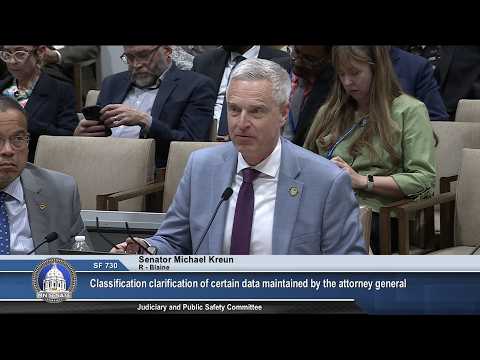
The Minnesota Senate Judiciary Committee on April 24 considered amendments to a Department of Human Services'back-grounding and program-integrity package. After DHS staff detailed changes to mental-health licensure, background-study authority and Office of Inspector General (OIG) procedures, the committee deleted a draft subdivision that would have allowed law enforcement to delay the 180-day customer-notification requirement in Minnesota Statute chapter 13A without seeking a court order.
DHS counsel Christie Graham told the committee the A4 amendment contains three articles: licensing changes for behavioral-health services, expanded background-study authority for specified high-risk programs, and OIG provisions including subpoenaing bank records and potential delay of consumer notification in limited circumstances. Graham said the package aims to modernize licensing and align with federal requirements for fingerprint and background checks.
Public testimony raised privacy concerns. Mr. Neumeister warned the delayed-notification language would let investigators "secretly seize our financial records" and repeatedly delay notice without judicial oversight. Senators and counsel debated the practical effects of the change; committee counsel and DHS staff said current law requires a court order to delay the 180-day notice, while the proposed text would create an exemption allowing the investigating agency to decide unilaterally. Senator Holmes moved to remove that subsection; the committee adopted the motion by voice vote.
The committee also adopted the A6 amendment creating a voluntary bank "trusted-contact" program to help detect fraud. Tess Rice, general counsel for the Minnesota Bankers Association, said the amendment is modeled on other states and limits civil liability for banks and designated trusted contacts who act in good faith, while keeping the program voluntary.
In a separate but related item, the committee approved a Commerce/Health technical amendment (A5) that clarifies data-sharing authorities as regulatory oversight of HMOs transitions between agencies. Department staff said the changes preserve nondisclosure protections required under Minnesota's data-practices law while enabling necessary market oversight analytics.
What happens next: Committee members asked DHS and Senate counsel to continue drafting language to ensure due-process safeguards and to supply any in-camera review language for payment-withhold procedures; the A4/A7 package was set aside for further work and the related amendments moved forward.