Get Full Government Meeting Transcripts, Videos, & Alerts Forever!
Get email alerts on the SF 730 Data Practices topic
No spam. Unsubscribe anytime.
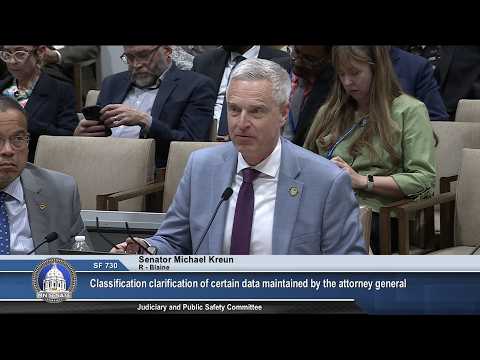
Senate Judiciary Committee deadlocks on bid to reverse AG data rules after heated debate
Summary
Senate File 7.30, a bill to narrow the Attorney General's ability to withhold broad categories of data under Minnesota's Data Practices Act, prompted hours of testimony and sharply divided the Judiciary Committee. Proponents urged transparency; Attorney General Ellison warned the change would hamper investigations and consumer-protection work.
Senate File 7.30, a bill that would amend Minnesota's data-practices statute to limit the Attorney General's ability to classify large categories of records as private, drew extended testimony and a failed referral vote in the Senate Judiciary Committee on April 24.
Senator Crewe introduced the measure as a response to the Minnesota Supreme Court's decision in Energy Policy Advocates v. Ellison, saying the court's ruling expanded the Attorney General's ability to treat nonindividual records as "private data on individuals." "This bill returns the statute to its prior, 40-year understanding and restores public access to policy and administrative records," Crewe told the committee (first presenting SF 7.30 at the committee hearing).
Supporters included Minnesotans for Open Government and other transparency advocates, who said the court's interpretation allowed the Attorney General's office to withhold draft policy, inactive investigative records and other items that historically were public. One advocate said the change has "afforded the AG a broader data-classification protection'that is untenable for an office with such power," and urged the committee to pass the bill.
Attorney General Keith Ellison urged the panel to reject the bill, telling senators the change would "impose tremendous and unprecedented burdens on the Minnesota Attorney General's Office and its ability to protect the people of the state." He said the proposal would chill consumer complaints, complicate cooperation in multistate litigation and reduce the AG's capacity to pursue fraud and consumer-protection cases. "Imagine a mom-and-pop business that fears retaliation if their complaint becomes public," Ellison said, adding that litigation and multistate partnerships would be jeopardized if data shared in those investigations could no longer be protected.
Oliver Larsen, an AG staff attorney who handled the Energy Policy Advocates litigation, disputed claims that the office had used the provision to withhold ordinary records; Larsen said many of the specific data sets at issue were either produced or not covered in prior requests. Consumer-protection staff also told the committee they rely on confidential consumer complaints and inactive-investigative data to build cases and said disclosure could chill reporting and harm enforcement.
Committee members pressed both sides on specifics: whether corporate complainants would be treated differently from individuals, how "consumer-complaint" data and inactive-investigative records would be classified, and what protections would remain for attorney-client or active litigation materials. Supporters said the bill would preserve established protections for active criminal and civil investigations, attorney-client privilege and work product while restoring public access to policy records.
After several hours of testimony and questions, the committee voted on a motion to refer SF 7.30 to the Senate Finance Committee for further review. The roll call showed four senators in favor and six opposed; the motion failed, effectively stalling the bill at that moment.
What happens next: supporters and the Attorney General's office said they were open to further talks and technical fixes, but no immediate compromise was reached. The committee paused further action on SF 7.30 pending additional negotiation and consideration of the bill's fiscal and procedural implications.