Get Full Government Meeting Transcripts, Videos, & Alerts Forever!
Get email alerts on the Pest Management topic
No spam. Unsubscribe anytime.
State officials outline proposed spongy moth mating-disruption treatment for Stewartville this summer
Summary
Minnesota Department of Agriculture officials detailed a U.S. Forest Service–funded mating-disruption treatment (SPLAT GM) for a roughly 3,200-acre Stewartville management block, explained the pest’s biology and outreach plans, and said treatment would be federally funded and require no local payment.
John Larson, interim spongy moth treatment coordinator for the Minnesota Department of Agriculture, told the Stewartville City Council that state and federal officials are proposing aerial mating-disruption treatment for a roughly 3,200-acre block near Stewartville in late June to early July to slow the spread of the invasive spongy moth (Lymantria dispar).
Larson said the U.S. Forest Service’s Slow the Spread program — a multi-state effort that Minnesota participates in — has reduced the pest’s projected westward expansion by more than 60% in recent years and that this treatment would be funded by the Forest Service, not the city. “This is all U.S. Forest Service funds,” Larson said, adding that the state and program partners are not asking Stewartville for money.
The nut graf: Officials described why the program targets mating disruption rather than direct insecticide application. The product to be used, SPLAT GM, is a species-specific pheromone formulation applied in small amounts by aircraft; it works by flooding the air with the female moth’s sex attractant so male moths cannot locate mates, reducing reproduction without killing insects directly.
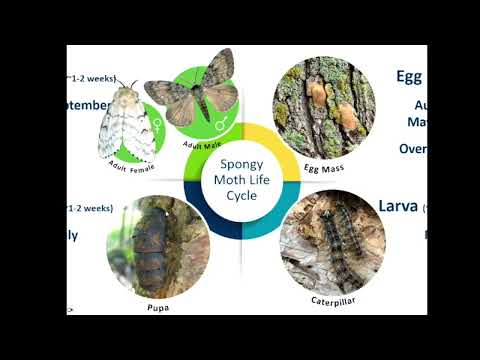
Larson explained the pest and the need for timing: spongy moth caterpillars feed on hundreds of tree and shrub species and heavy defoliation can weaken trees and invite secondary mortality. Egg masses overwinter and can contain roughly 500–1,000 eggs each, so populations can expand rapidly. “The caterpillars do 70% of their feeding in the late-instar stage,” Larson said, noting that in southern Minnesota the late-instar feeding peak often occurs around the July Fourth week.
On operations, Larson said aircraft would fly about 100 feet above the tree canopy and that booms would be turned off over open water and areas without canopy. The application rate described in the presentation is low (about 34 grams per acre), and the product is described as biodegradable and non-toxic to humans and most non-target species. “It’s not even toxic to spongy moth. No human health effects or concerns,” Larson told the council.
Officials also described outreach: every address in the proposed management block would receive an informational postcard, and residents could attend an in-person town hall at the Civic Center on April 1 (4:30–6 p.m.) or a virtual session April 7; an online sign-up would allow email or text notifications before and after treatment. Larson said site-specific environmental assessments will be completed to evaluate potential effects on rare or threatened species and that the project team is coordinating with Olmsted County emergency management and neighboring cities such as Rochester.
During a public question-and-answer period, residents asked about the recent change in common name from “gypsy moth” to “spongy moth,” regional spread projections and the role of cold weather in reducing populations. Larson said the name change follows national entomological society conventions and that while cold can increase mortality, sheltered microhabitats and the pest’s cold tolerance make cold alone unlikely to eliminate outbreaks. He also said land-cover differences (for example, areas without canopy or agricultural land) help explain apparent boundaries in spread maps.
The presentation closed with officials offering contact information and the informational packet; they noted treatment is contingent on federal funding continuing to be available.
Next steps: the presenters said residents will receive direct mail and electronic notifications in the weeks before any treatment window and that follow-up monitoring of trap catches would be used to assess the treatment’s effectiveness in subsequent seasons.