Get Full Government Meeting Transcripts, Videos, & Alerts Forever!
Get email alerts on the City Budget Overview topic
No spam. Unsubscribe anytime.
Isanti City staff outline 2026 draft budget with 3.8‑mill levy; water and sewer show shortfalls
Summary
City staff presented a draft 2026 budget proposing a 3.8 mill levy, department-level operating increases and enterprise fund shortfalls: a projected $149,000 water deficit and a $48,000 sewer shortfall. Council pressed staff on contingency assumptions, LMC dues and how transfers affect the general fund.
City staff presented the draft 2026 budget at a work session, saying the proposed total levy would be about 3.8 mills and that the overall tax rate would remain roughly even with 2025.
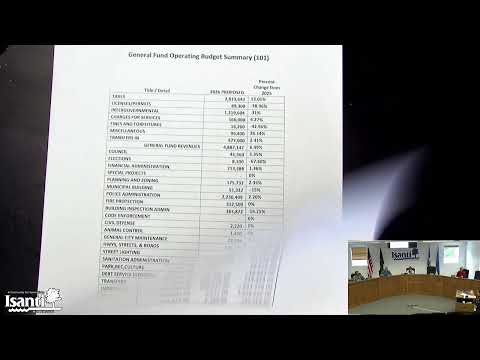
The packet summarized department requests and changes: the city council line shows a 5.35% increase to cover higher costs for legal notices and League of Minnesota Cities (LMC) dues, while elections are projected to be down about 68% reflecting the cost of a special election in 2025 and a comparison to non‑presidential election years.
Staff highlighted several department drivers: financial administration is up roughly 1.36% largely for technology investments and the newly required Minnesota paid leave payments; planning and zoning is up about 2.35% because of personnel cost-of-living adjustments; municipal building utilities were trimmed based on lower utility estimates.
Enterprise funds showed stress: staff projected the water fund would post a negative net income of about $149,000 in 2026, noting capital expenditures are included in the current budget year and will ultimately be moved to capital asset accounts and depreciated. Water sales revenue was estimated at roughly $1.5 million. The sewer fund was projected to show a net loss near $48,000, again because capital costs are budgeted in the year shown.
Staff and council discussed the long‑term debt picture: the debt‑service fund is slated to retire the city’s final general obligation debt payment in 2030, with general‑fund debt payments visible through 2031 in other schedules. The EDA operating fund showed a projected net income of about $48,000; staff said the packet’s $176,000 figure represents the maximum EDA levy capacity for 2026 based on estimated market value and that council could reduce transfers from EDA to the general fund to preserve reserves for a planned digital sign.
Regarding internal transfers, staff explained that the municipal liquor store is projected to show a roughly $24,000 net operating loss after transfers; staff also clarified the anticipated profit before transfers is roughly $440,000 and that a $462,000 transfer to the general fund was included to offset prior deficits, which prompted council questions about the mechanics of interfund transfers.
Council members repeatedly asked staff to return with more precise line‑item detail and historical comparisons, including a request to present police capital (vehicle) costs alongside operating numbers so residents can see the full police budget. Staff repeatedly said more detailed breakdowns and CIP entries will be available in subsequent budget packets.
The work session concluded with staff asking for direction on several contingency items and with agreement to revisit several estimates (website hosting, scanner subscriptions, engineering contingency) before final adoption. No formal votes or actions were recorded in the portion of the transcript provided.