Get Full Government Meeting Transcripts, Videos, & Alerts Forever!
Get email alerts on the Immigration Enforcement And Local Policing topic
No spam. Unsubscribe anytime.
WSBA panel: Local police say federal ICE operations without deconfliction can erode trust and create safety risks
Summary
Local law enforcement leaders told a Washington State Bar Association panel that inconsistent federal immigration operations and reduced coordination with local agencies have strained community trust and increased risks; panelists urged clear deconfliction, adherence to Keep Washington Working, and use of documentation and community outreach.
Tara Evett, executive director of the Washington State Bar Association, opened a lunchtime panel on conflicts between federal immigration enforcement and local policing and introduced three experts: David Montes of the ACLU of Washington; Professor Liz Porter of the University of Washington School of Law; and Steve Strand, executive director of the Washington Association of Police Chiefs and Sheriffs.
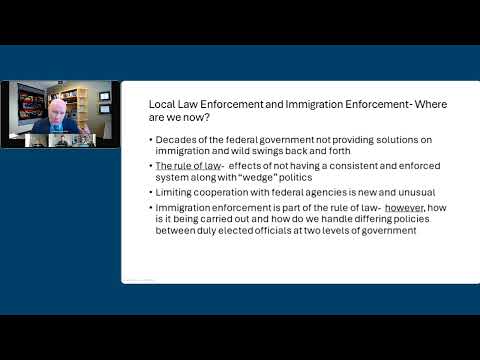
Steve Strand said civil immigration enforcement is ‘‘entirely the jurisdiction of the federal government’’ and stressed that Washington’s local agencies generally do not enforce immigration status because of the Keep Washington Working policy. He told attendees that when federal and local agencies ‘‘deconflict’’—that is, share plans to avoid operational clashes—community safety and constitutional policing are preserved. But Strand said that coordination has broken down in some high-profile federal operations, citing Operation Metro Surge in Minnesota and reports from Portland, and that unannounced federal activity can create dangerous confrontations and erode public trust.
Strand described practical guidance used by local agencies: distinguishing lawful protest from obstruction, documenting incidents, and encouraging residents to call 911 rather than assume local officers are assisting federal authorities. He said local agencies aim to ‘‘protect everyone without any regard to immigration status’’ and that officers ‘‘do not ask about immigration status’’ when responding to crime victims.
The panel acknowledged that local law enforcement must balance respecting federal authority, avoiding obstruction (which can be a felony), and maintaining community trust. Strand pointed to a December 2024 statement from the state sheriffs and chiefs and an early-January 2026 set of shared principles from national law-enforcement groups that prioritize targeting violent offenders and protecting constitutional rights.
Professor Liz Porter and David Montes joined the discussion to explain how those practical problems interact with legal constraints. Porter said legal remedies for contested federal operations are often limited and complex, while Montes outlined narrow civil avenues such as the Federal Tort Claims Act and certain state statutes or claims that might reach federal actors under specific circumstances.
The panel concluded by urging legal volunteers to help file habeas petitions and advising lawyers and community leaders to calmly inform neighbors about rights and local policies. Evett said the WSBA will post slides and recordings and email resources to attendees.
The session ended with a Q&A follow-up promise and a reminder that the series’ materials will be posted on the WSBA ambassador web page.