Get Full Government Meeting Transcripts, Videos, & Alerts Forever!
Get email alerts on the Budget topic
No spam. Unsubscribe anytime.
ULCT board approves Q3 budget report, flags reserve use and event revenue shifts
Summary
At its St. George midyear meeting, the Utah League of Cities and Towns approved the Q3 FY2026 budget report and check register. Staff reported core revenues largely on pace, one-time reserve spending for projects, and stronger-than-expected sponsorship/exhibit revenue that offset weaker convention registration.
The Utah League of Cities and Towns board, meeting in St. George, voted to approve the organization’s Q3 budget report and accompanying check register after staff presented revenue and expenditure performance through March 31, the end of the third quarter of FY2026.
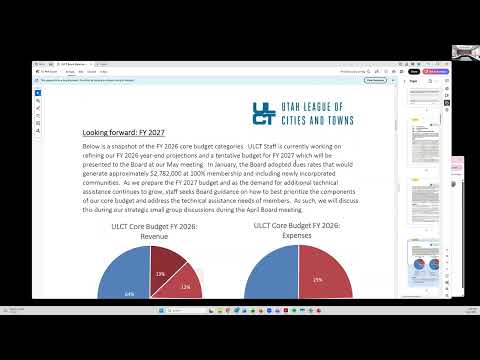
A staff presenter summarized the figures and said the League had collected the bulk of its general revenue and remained broadly on pace for the year. Membership dues constitute the largest share of core revenue, while sponsorship and exhibit income have outperformed expectations; registration revenue tied to the annual convention lagged behind targets. Staff also described state-funded technical-assistance grants received this year, including a $50,000 grant for data privacy and an upfront payment of $189,000 from a two-year Department of Workforce Services grant budgeted up to $700,000 in total.
Staff noted the board had included roughly $293,000 of unrestricted reserves in the current-year budget to underwrite one-time projects. Those one-time expenditures — and an estimated $82,000 in planned spending not yet realized in the first three quarters — will reduce reserves when incurred but were presented as deliberate, policy-driven uses of funds. On expenditures, staff reported personnel and event costs were the material categories, with personnel running materially in line with plan and event spending driving a notable share of discretionary outlays.
During the presentation, staff emphasized steps taken to bring event budgets into balance, including formalized sponsorship programs and an expanded exhibit hall that has helped keep attendee registration rates relatively flat while increasing net event revenue.
A board member moved to approve the Q3 budget report and check register; the motion was seconded and approved by voice vote. Staff said the report and the board’s input would feed into the tentative FY2027 budget presented at the May meeting.
What happens next: staff will continue to monitor convention registration and the execution of one-time projects; the board will consider the tentative FY2027 budget and procedural rules for the public budget hearing in May.