Get Full Government Meeting Transcripts, Videos, & Alerts Forever!
Get email alerts on the Solid Waste topic
No spam. Unsubscribe anytime.
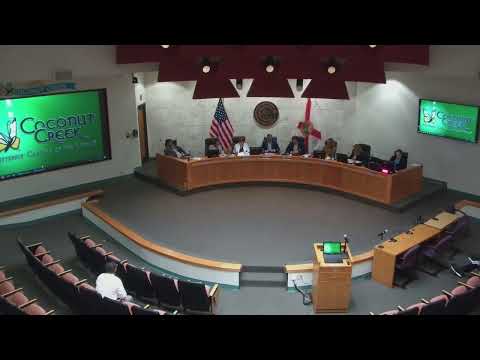
Coconut Creek votes to join Broward Solid Waste Authority; commission approves facilities amendment
Summary
The City Commission approved an amendment to join the Broward Solid Waste Authority, endorsing a tipping‑fee surcharge starting in FY28 and later non‑ad valorem assessments to fund countywide recycling and drop‑off centers; commissioners stressed opt‑out protections and long‑term oversight.
The Coconut Creek City Commission voted unanimously April 23 to approve the first amendment to the interlocal agreement that will allow the city to participate in the Broward Solid Waste Authority’s facilities and processing program.
City staff told commissioners the amendment shifts the authority away from owning new facilities toward contracting with existing regional infrastructure and sets maximum disposal costs intended to protect member communities. Michael (staff) said the initial mechanism to fund the authority will be a tipping‑fee surcharge beginning in fiscal 2028, and that a non‑ad valorem assessment is planned for later years to provide a more stable revenue base.
Sam May, interim executive director of the Broward Solid Waste Authority, gave local cost context, saying the early surcharge equates to roughly $2.22 per ton in the authority’s accounting and that, for Coconut Creek, the initial estimated cost would be small on a per‑resident basis. "If it's a utility bill, you're looking at, you know, 27, 28 cents per month," he said.
Commissioners pressed staff on governance and exit provisions given prior county facility controversies. In response, staff and the city attorney confirmed that municipalities retain the ability to opt out. "We can opt out of it anytime," a staff speaker said during the discussion, and the city attorney affirmed that representation on the record.
Public comment supported regional action and stronger recycling outreach. Resident Susan Stein Hauser urged hands‑on neighborhood education and suggested pay‑as‑you‑throw as a longer‑term option, saying, "I think pay as you throw is something to consider." Commissioners and staff also discussed composting models used by other cities and the potential sequencing of yard‑waste and food‑waste programs.
After discussion, the commission approved the resolution authorizing the mayor or designee to execute the facilities amendment. The amendment anticipates rollout of recycling drop‑off centers, household hazardous‑waste funding, and harmonized disposal contracts across participating Broward municipalities; implementation details and specific resident fees will be refined with finance staff prior to billing changes.
The commission directed staff to continue outreach and to return with implementation timelines and public education materials. The resolution passed by roll call vote with all members voting yes.
Next steps: staff will finalize financial modeling with the authority and prepare resident notices and outreach plans ahead of any surcharges or assessments.