Get Full Government Meeting Transcripts, Videos, & Alerts Forever!
Get email alerts on the Zoning Overview topic
No spam. Unsubscribe anytime.
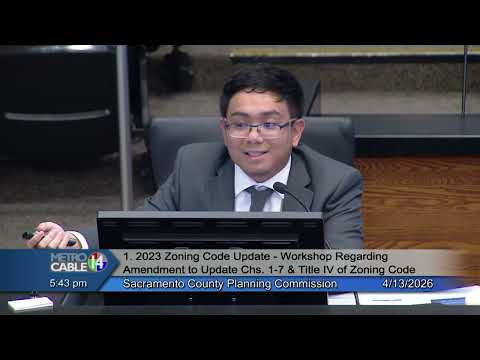
Sacramento County planning staff preview 131‑item zoning overhaul, seek commissioner feedback
Summary
Planning staff presented a countywide zoning ordinance update of 131 proposed amendments, explaining the package, public outreach, and next steps; commissioners pressed staff on enforcement, neighborhood impacts, and conflicts between corridor policies and new standards.
Planning Department staff presented an informational workshop April 13 to the Sacramento County Planning Commission on a countywide package of zoning ordinance amendments that contains 131 distinct items spanning commercial, institutional and residential chapters.
Wendy Hartman, principal planner, introduced the session and Matthew Jamomi, lead planner on the package, said the update is the most substantial since 2015 and was drafted with the Board of Supervisors’ 2023 direction to expand ministerial and by‑right approvals where appropriate. Jamomi said staff organized the proposals into a matrix that lists each item, affected code sections, a short summary and a subjective degree of change (1–5). He said the set includes 45 rank‑1 clarifications and 14 rank‑5 policy changes, and that staff will present a formal recommendation to the commission in June with final Board action slated for July.
The presentation outlined broad themes: clarifying and consolidating use classifications; modernizing temporary uses (pods, tents, events); updating vehicle‑related standards and accessory vehicle storage; new animal and pet service classifications; updated death‑care and body‑art provisions; and new standards for utility‑scale battery energy storage systems. Jamomi emphasized the workshop was non‑voting and intended to collect commissioner and public feedback.
Commissioners focused on enforcement and policy tensions. One commissioner said simplifying review levels and expanding administrative approvals could make some rules harder to enforce and asked staff to consider enforcement burdens. Another highlighted a potential conflict between the countywide drive‑through reservoir standards and local transit‑oriented development (TOD) plans that restrict drive‑throughs; staff said corridor‑specific infill planning will create tailored standards for identified transit corridors.
Hartman said staff has conducted outreach at all CPACs and CMACs and the countywide workshop and is incorporating community input. No formal actions were taken at the workshop. Staff invited written comments before the June recommendation hearing.