Get Full Government Meeting Transcripts, Videos, & Alerts Forever!
Get email alerts on the Natural Environment topic
No spam. Unsubscribe anytime.
Commission presses for clearer buffers, enforcement and rural‑preservation tools in plan update
Summary
The commission reviewed natural environment and rural preservation chapters, asking staff to link preservation language to county ordinances, to strengthen buffer language, to pursue entrance‑corridor overlays, and to add a clear enforcement posture naming the code compliance officer.
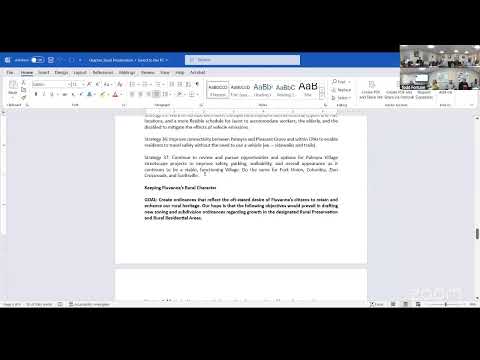
Fluvanna County planning commissioners used the work session to scrutinize natural‑environment text and a new rural preservation section drawn from the Rural Preservation Advisory Group report. Commissioners sought clearer, ordinance‑linked language and stronger commitments to implementation and enforcement.
On natural resources, members recommended editing aspirational phrasing (for example, changing "open spaces should be preserved" to language that ties preservation to codified county ordinances so the plan supports future ordinance updates). Commissioners asked staff to add explicit references to buffers between incompatible uses (agriculture and housing, septic constraints in small towns) and to ensure maps and charts are correctly captioned with year ranges.
On rural preservation, staff presented a new section that lists gateway routes (US‑15, Route 53, Route 6) and identified Community Planning Areas (CPAs). Commissioners recommended distinguishing historic villages such as the village of Palmyra from broader CPA boundaries and flagged overlay approaches (village or entrance‑corridor overlays) as preferable to blunt rezoning. Several members asked staff to revisit whether specific parcels should remain in listed CPAs or be handled via overlays to better protect historic village character.
Enforcement repeatedly surfaced as a practical obstacle. Commissioners said county ordinances and goals are only effective if enforced and noted that many residents do not know a code compliance officer exists. The commission directed staff to add implementation language that "establishes a posture to ensure compliance with existing ordinances through the code compliance officer" and to remove duplicative strategies that would be covered by an enforcement implementation task.
Quotes: "Establish a posture to ensure compliance with existing ordinances through the code compliance officer," a commissioner said, reflecting the group’s direction to link plan aspirations with a named compliance mechanism.
Ending: Staff will revise natural‑environment wording to reference county ordinances and buffer standards, review CPA and village boundaries (Palmyra and other historic areas) for possible overlay protections, and add implementation language that clarifies enforcement responsibilities and public reporting channels.