Get Full Government Meeting Transcripts, Videos, & Alerts Forever!
Get email alerts on the Comprehensive Plan Vision topic
No spam. Unsubscribe anytime.
Commission debates whether comp‑plan text should reflect board vision or a separate 'Vision 2045'
Summary
Fluvanna County planning commissioners reviewed an expanded introduction and debated whether the draft vision language should remain the board of supervisors' mission, a comp‑plan‑specific vision, or be recast as goals and objectives; commissioners voted to seek board guidance and scheduled a joint work session.
Fluvanna County planning commissioners spent the bulk of a special work session reviewing the proposed introduction and vision statement for the county’s comprehensive plan update, disagreeing over whether the language represents the Board of Supervisors' adopted mission or a comp‑plan‑specific vision.
Commissioners said the draft introduction expands the 2015 text and incorporates language from the Code of Virginia explaining the legal basis for local comprehensive plans. The presenter noted the text pulls verbatim material from the Code (15.2‑223 and subparagraphs) and suggested putting full code language in an appendix and an electronic link in the online version so readers can review the statute directly.
Members then focused on the vision language. One commissioner said the draft’s phrase 'harmonious development' should not appear without acknowledging that the county is experiencing tension between residential neighborhoods and industrial or commercial proposals, calling for the introduction to 'leave a marker' that the commission intends to address those clashes through setbacks, vegetative screening and clearer ordinances. Others warned the phrase could be read as conflict with the board's adopted mission.
The commission debated three options: (1) treat the draft as the board’s mission (and leave the original wording intact), (2) adopt a comp‑plan‑specific vision labeled clearly as such (for example, 'Vision 2045 — comprehensive plan'), or (3) recast the material as goals and objectives (the format commonly used in plans). Several commissioners favored option 2 or 3 to protect the commission’s edits from being read as replacing the board’s mission.
Rather than force a unilateral decision, commissioners asked staff to request a joint work session with the Board of Supervisors so the board can review the commission’s suggested edits and advise whether the document should contain the board’s mission, a comp‑plan vision, or both. Staff said they had planned later joint sessions and will flag the vision question as a priority for board discussion.
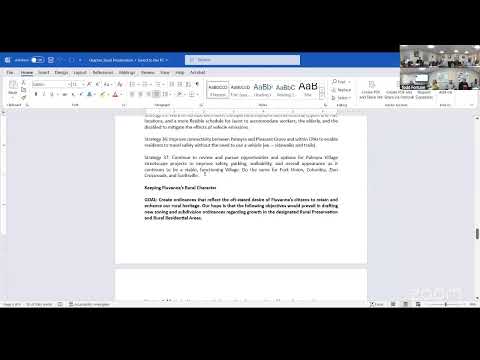
Next steps: staff will (a) correct factual and formatting issues noted in the introduction (for example, community meeting language that implied one meeting in every election district), (b) add an electronic link to cited code sections in the online draft, and (c) schedule a joint work session with the Board of Supervisors to clarify whether the commission should preserve the board’s mission wording or recommend a comp‑plan vision. The commission agreed to take up the rural preservation section at a follow‑up meeting on May 26.
Quote: "We were asked to edit this; we edited it. We would like the Board to look at what we did," Commissioner (Committee member) said, arguing the commission should send the board the proposed vision language and get direction before finalizing the introduction.
Ending: The commission left the contested language in place for now and asked staff to package the question for the Board of Supervisors; the work session then proceeded to other plan sections.