Get Full Government Meeting Transcripts, Videos, & Alerts Forever!
Get email alerts on the Vision Zero Safety Corridors topic
No spam. Unsubscribe anytime.
Tempe previews Vision Zero corridor activations and ramps up enforcement after recent crash data
Summary
City staff said four safety corridors will be activated this quarter as part of Tempe's Vision Zero program, citing a 14% overall decline in serious and fatal crashes on activated corridors and outlining enforcement plans including motorcycle patrols and possible mobile speed cameras.
Tempe staff on April 30 described the city's upcoming safety-corridor activations and enforcement plans tied to the Vision Zero goal to eliminate severe injury and fatal crashes.
Ellie, the presenter for the session, said Vision Zero was adopted by the Tempe City Council in 2019 and is being updated through the Transportation Master Plan 2050. "Vision Zero is a goal that the City Council has adopted to reduce the number of serious injury and casualty crashes to zero," she said, and noted 2025 crash data remain incomplete until final figures arrive from the Arizona Department of Transportation around mid-year.
The presentation showed a multi-year heat map and identified four corridors to be activated this quarter: 48th Street (Broadway to Southern), Baseline Road (Kyrene Road to Priest Drive), McClintock Drive (Don Carlos Drive to SR 202) and McClintock Drive (Southern to Baseline). Staff said the safety-corridor rotation that began at the end of 2023 has corresponded with a drop in fatalities and that a corridor-by-corridor comparison (2024 vs. 2023) shows a 14% overall decrease in combined serious-injury and fatal crashes while acknowledging some corridors saw unchanged or slightly increased crash counts.
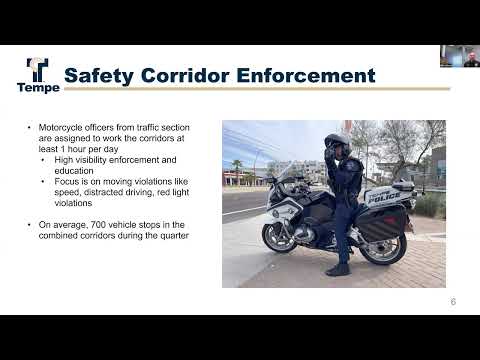
Lt. Greg Bacon of the Tempe Police Department's traffic section described enforcement expectations inside activated corridors: "Our motorcycle officers from our traffic section are assigned to work the corridors at least 1 hour per day," he said. Bacon said the daytime motorcycle detail includes five officers, vehicular-crimes detectives are deployed when available, and the typical quarterly deployment has produced about 700 vehicle stops.
Staff outlined engineering responses under consideration for targeted corridors, including signal-timing changes, trimming foliage to improve sign visibility, relocating signs and stripe maintenance. The presenter said mobile speed cameras are a possible, but not certain, addition during deployments.
During public comment, resident Rob Skroban, who said he lives near Fry's Electronics, described what he called a noticeable increase in speeding and drivers running red lights over the past five years. "The speed limit in this area is 45 mph'... people go from stoplight to stoplight, full acceleration," Skroban said, urging lower speed limits and enforcement tools such as speed and red-light cameras.
Staff replied that the city is reviewing speed limits and expects proposed speed-limit changes to appear on the City Council agenda on April 30; changes to those limits require council approval under Tempe code. On micromobility, staff said Tempe's micro-mobility team is drafting possible city-code language to address scooters, e-bikes and bicycles and is reviewing approaches used by neighboring cities.
The presentation also outlined a one-hour bicycle-and-pedestrian diversion class available through tempe.gov/police: the class is free to take voluntarily; if taken as part of a citation the fee is $50, staff said. Officials noted complexities in e-bike classification (for example, watt levels and whether pedals are operable) and said the subcommittee will work to clarify local code language.
Resident Nicole reported late-night street racing and "donuts" in the McClintock corridor, sometimes at 1:30 a.m. and 4:30 a.m.; staff said patrol officers and a night traffic squad respond to those complaints and urged callers to report dangerous driving in progress to 911.
Staff said the city will post the recording and contact information on the project webpage within days. The presentation ended with staff thanking residents for feedback and noting ongoing work to refine corridor activations, enforcement and code language.
The next procedural step noted in the session was that any proposed speed-limit code changes must be approved by the Tempe City Council (agenda item expected April 30).