Get Full Government Meeting Transcripts, Videos, & Alerts Forever!
Get email alerts on the Strategic Plan topic
No spam. Unsubscribe anytime.
Taos Municipal Schools board finalizes core-value language, drafts mission and schedules community input
Summary
At a special April 24 meeting the Taos Municipal Schools Board refined five draft core values (ethics, excellence, equity, empowerment/engagement and innovation), agreed a concise vision and worked the wording of a mission emphasizing partnerships and student readiness; staff and consultants will run a community-input meeting in mid-May and the board set a May 4 follow-up to finalize goals.
President Mark Flores convened a special Taos Municipal Schools Board of Education meeting on April 24 to continue work on the district's strategic plan, and the board reached tentative agreement on a set of core values and draft vision and mission language while scheduling follow-up steps for public engagement and goal-setting.
The board's consultant, David Chavez of CES, outlined a community-input format that would invite roughly eight targeted subgroups (students; certified and non-certified staff; administration and board members; community members; government officials; Native community representatives; and business leaders). "Normally the process we follow ... is to conduct a community meeting for the purpose of seeking that community input. ... That's about a three to three and a half hour process," Chavez said, describing a brainstorming, peer-ranking and stratified-group approach the consultant said helps produce prioritized needs the district can weigh into its goals.
Why it matters: Board members said they want the strategic plan's goals to be both measurable and manageable. Several trustees pressed for student-centered metrics (grade-level proficiency and college/career readiness), but also stressed nonacademic priorities such as attendance, staff support and students' social-emotional wellness. The board and consultants agreed to refine a small number of high-level, districtwide goals that the superintendent and staff will translate into campus-level measures and action plans.
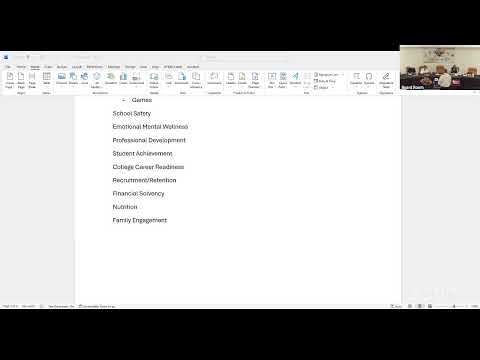
What the board approved in draft: Through iterative discussion and live edits (including on-screen text the group reviewed), trustees settled on the following set of core concepts to appear in the plan: ethics (including transparency and respect), excellence (framed around quality, collaboration and accountability), equity (valuing diverse backgrounds and ensuring access to resources), empowerment/engagement (valuing and inspiring participation from students, staff, families and stakeholders) and innovation (encouraging continuous growth through creative thinking and appropriate new technologies). Members debated whether "innovation" should be a stand-alone value or embedded under excellence and agreed to preserve the concept and refine placement for public messaging.
On mission and vision: The board narrowed three candidate vision statements to a concise option focused on a transformative culture that inspires innovative learning, and worked toward a mission that emphasizes partnerships and student readiness. Board discussion produced a working mission draft emphasizing meaningful partnerships and preparing "every student with the academic, social-emotional wellness, critical thinking, resilience and integrity needed to thrive in college, careers and a changing world." Participants also asked staff to add wording that clarifies a safe, supportive learning environment.
Quotes from the meeting: "We strive and demonstrate the highest standards of quality and accountability in academic and personal growth by learning from others, working as a team, and acting responsibly," Superintendent Leighton read back during wordsmithing of the excellence statement. Consultant David Chavez described the community session: "We will then assign the individuals to one of those eight subgroups ... they'll take the needs that are identified and they will prioritize that list." Board members also discussed the role of well-being: one trustee urged that students be "emotionally and mentally well to be able to learn," linking wellness to academic progress.
Next steps and schedule: The board asked Chavez and staff to convene the community meeting in mid-May (staff and trustees discussed May 14 as a likely date and 5:30 p.m. as a start time) and agreed to a special board follow-up session on May 4 (4–6 p.m.) to finalize measurable goals and guard rails before the community meeting. Chavez committed to produce a written report within a week of the community session summarizing participant rankings and recommendations.
Votes and procedural actions: The board voted to approve the meeting agenda at the start of the session; it recessed briefly by motion and later reconvened. The meeting concluded with a motion to adjourn and was formally closed. (All procedural motions were taken as reflected in the minutes; no substantive ordinances, contracts or policy adoptions were voted on.)
What remains: Trustees directed staff and the superintendent to return with more specific, measurable goal proposals (for example, target percentage increases in proficiency) and with options for how the district will monitor and report progress. The board also requested that the community meeting materials and invitations be prepared and circulated 3–4 weeks in advance to maximize participation.
What's next: The board set a follow-up special session for May 4, 4–6 p.m., to finalize goals and guard rails, and a regular board meeting is scheduled for May 6 at 6 p.m.
(Reporting note: quotes and paraphrases are drawn from the April 24, 2026 board transcript. All attributions map to speakers recorded on the meeting record.)