Get Full Government Meeting Transcripts, Videos, & Alerts Forever!
Get email alerts on the Land Use Data Centers topic
No spam. Unsubscribe anytime.
Planning & Zoning split on 828‑acre data‑center rezoning after hours of resident objections
Summary
After more than three hours of public comment, Red Oak’s Planning & Zoning Commission declined to recommend approval of an 828.8‑acre Planned Development intended to host data‑center buildings, voting 2–3 against the city‑initiated rezoning; supporters cited infrastructure and tax benefits while neighbors raised water, noise and traffic concerns.
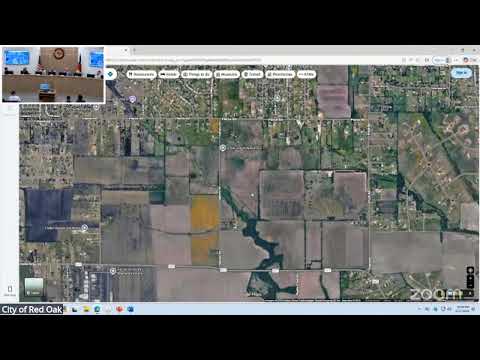
The Planning & Zoning Commission on April 27 stopped short of recommending approval for a city‑initiated rezoning that would convert roughly 828.8 acres on the city’s east edge into a high‑tech industrial park oriented to data‑center uses.
Commissioners voted 2–3 against the proposed PD after an extended public hearing that drew more than 30 residents and stakeholders to the podium. Those who testified opposed the rezoning on grounds that large data centers could strain water supplies, worsen electric reliability, create noise and light pollution, lower nearby property values and permanently remove farmland and housing opportunities.
The city presented the rezoning as a planned step to attract data‑center development on land owned by the Red Oak Industrial Development Corporation. Staff said the PD would include on‑site screening and standards copied from existing local data‑center sites, and that developers typically pay for substantial off‑site electrical and water improvements (including substations and larger water mains) needed to serve those facilities. City Manager Todd Fuller told the commission that developers bring infrastructure investments and that, at scale, the additions can sharply increase the city’s taxable value and pay for public amenities without raising residents’ property tax rates.
Residents pressed a different case. "What does this do to our water and our children's future?" a Pratt Road resident asked, citing worries about coolant systems, underground runoff and potential contamination. Several speakers pointed to recent grid interruptions and asked whether the local electric network could reliably carry the new load. Others asked for independent environmental and property‑value studies before the council acted.
Scientists and community members asked for more transparency and conditions. Dr. Matthew Price, an AI researcher who testified from nearby Pierce Road, urged denial or at least tabling of the item so the public could see any due‑diligence materials, letters of intent or engineering studies that might exist. Resident Rolando Sustaita submitted a written list of binding conditions — including masonry walls adjacent to homes, a FEMA‑compliant flood and drainage study before permitting, noise limits of 65 dBA at residential property lines and restrictions on after‑hours construction — and asked the commission to require them before approving any rezoning.
In response, Todd Fuller and staff described common design practices for modern facilities: most local campuses under construction rely on air‑cooled, closed‑loop systems using propylene glycol rather than continuous city water, and developers typically pay to extend power and water mains and to build substations on their own dime. Fuller also said that planned‑development zoning lets the city attach site‑specific conditions — screening berms, lighting limitations and noise standards — that do not exist in standard industrial zoning.
Commissioner discussion focused on mitigation measures and enforceable limits. Commissioners proposed reducing the allowable continuous sound level from 85 dBA to 70 dBA, requiring berming plus landscaping and fencing where development abuts residences, codifying lighting limits to prevent spillover across property lines, setting minimum building setbacks (about 150 feet was discussed) and restricting routine construction hours (proposed 7 a.m.–7 p.m.). A motion to recommend approval with those conditions received two votes in favor and three opposed; the motion failed, so the commission did not forward a recommendation to the City Council.
The rezoning will next appear before the Red Oak City Council on May 11. The commission’s split recommendation and the length of the public hearing mean council members will receive a substantial record of neighborhood opposition and suggested conditions when they consider the proposal.