Get Full Government Meeting Transcripts, Videos, & Alerts Forever!
Get email alerts on the Property Tax Refund topic
No spam. Unsubscribe anytime.
Proposal to expand property-tax refunds and create a tax‑compliance unit fails to clear committee referral
Summary
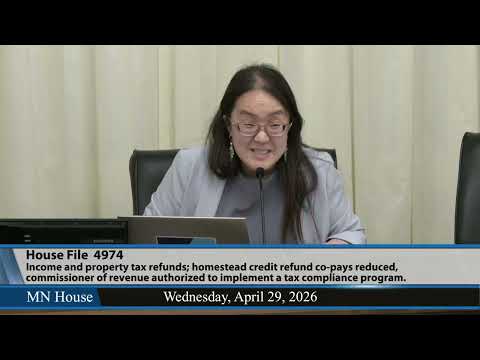
Representative Lee told the Tax Committee House File 4974 would expand property-tax refunds for roughly 476,000 homeowners (average increase estimated about $93) and fund a new $15 million/year Department of Revenue audit unit, but a roll-call referral to Ways and Means did not prevail in committee.
Representative Lee presented House File 4974 as a two-part proposal: broaden property-tax refunds for an estimated 476,000 homeowners (the sponsor said the average increase would be roughly $93) and establish a new Department of Revenue compliance program with ongoing funding of $15 million per year to expand audit capacity. The sponsor framed the approach as paying for expanded refunds by targeting large, complex and multinational taxpayers and cited prior state experience that compliance work can generate multiple times the investment in recovered revenues.
Members probed the bill’s inclusion of an explicit revenue estimate in statutory language. Representative Robbins called the statutory revenue language “very unusual” and asked where the figures originated; Representative Lee and staff said the numbers reflected internal analysis and prior returns to compliance functions (the sponsor described a conservative one-to-four return). A Department of Revenue legislative director at the table said the agency would need to follow up offline about the handling of revenue shortfalls and did not identify a statutory mechanism for handling projected shortfalls.
Representative Howard requested a roll-call vote on the motion to refer the bill to Ways and Means. The clerk conducted a roll call; the transcript records a tally of "11 ayes and 6 nays" and then records the line "The motion does not prevail." The Committee did not move the bill forward to Ways and Means during this hearing.
Representative Lee said the bill aims to shift collection attention toward corporations and complex pass‑through entities and that the Department’s new audit resources would be prioritized toward returns with higher expected yields. Supporters called the bill a way for the state to "fill the gap" of reduced federal audit capacity. Department staff said they would need follow-up conversations on operational details and the statute’s language.
Next steps: the bill may be reintroduced or returned to committee for further fiscal analysis; staff follow-up with the Department of Revenue was requested in committee.