Get Full Government Meeting Transcripts, Videos, & Alerts Forever!
Get email alerts on the Voting Rights topic
No spam. Unsubscribe anytime.
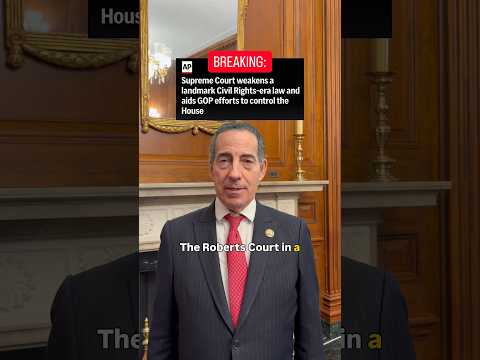
Committee member says Supreme Court ruling in Calais case weakens Voting Rights Act
Summary
A committee member told the House committee that a 6-3 Supreme Court decision in the Calais case out of Louisiana "completed its demolition of the Voting Rights Act," and urged political organizing and structural redistricting reforms as remedies.
A committee member said the U.S. Supreme Court's 6-3 decision in the "Calais" case out of Louisiana "completed its demolition of the Voting Rights Act," and described the ruling as allowing partisan redistricting that can split majority-Black or Hispanic districts without triggering Voting Rights Act violations.
The speaker framed the decision as politically advantageous to Republicans. Asked "Was it considered a win for who?" the committee member answered, "A win for Republicans," and went on to explain how the Court's reasoning treats partisan and racial gerrymanders differently.
"If you take a majority black or Hispanic district and you cut it in half, you dismember it, that doesn't violate the Voting Rights Act anymore as long as you describe it as a partisan gerrymander," the committee member said. The speaker added that deliberately creating a majority African American or Hispanic district could still be characterized as a racial gerrymander and therefore unconstitutional under the Court's framework.
The member said the ruling "drains what's left out of the meaning of the Voting Rights Act of 1965," and called for "massive political mobilizing and organizing to overcome it." As a policy response, the committee member urged Congress, once controlled by a pro-democracy majority, to pass nonpartisan redistricting commissions, adopt multi-member districts and pursue proportional representation to limit partisan gerrymanders.
The excerpt contains commentary and proposed policy fixes; it does not record a formal vote or specific legislation introduced during this session. The remarks were presented as an urgent briefing to the committee and framed by the speaker as "breaking news."