Get Full Government Meeting Transcripts, Videos, & Alerts Forever!
Get email alerts on the Land Use Stewardship topic
No spam. Unsubscribe anytime.
Beneficiary groups present competing plans to steward Monaka access road, promise revenue to help housing for long wait‑list
Summary
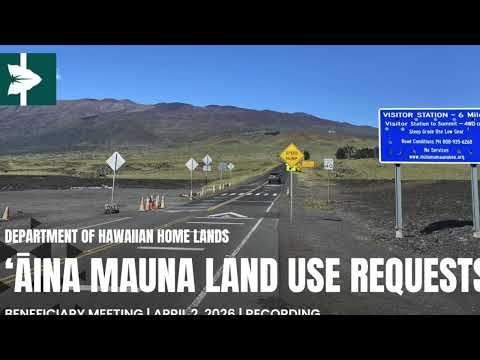
Two beneficiary-led proposals for stewardship and access management of the Monaka access road and the C1 parcel were presented to DHHL beneficiaries. Presenters said the plans would protect cultural sites and generate visitor revenue (applicants cited roughly $3.5M/year) to accelerate housing for wait‑listed Native Hawaiians; attendees raised concerns about competition and DHHL’s process. Comments due May 1.
Two Native Hawaiian beneficiary groups presented competing proposals to steward the Monaka access road and adjacent C1 parcel at a Department of Hawaiian Home Lands (DHHL) beneficiary consultation meeting. The proposals, presented by Mike Hudson for the YA Homestead Association and by Dr. Kalania Wilson for the Hawaiian Humanitarian Alliance (also called Ka Kia in testimony), both framed stewardship, cultural protection and community benefit as central aims while proposing revenue models to fund long-term maintenance and housing for beneficiaries.
Mike Hudson, president of the YA Homestead Association, described his group’s proposal as a beneficiary‑led stewardship plan rooted in decades of homestead organization and local governance. Hudson told beneficiaries the association has invested in infrastructure on community lands and emphasized that stewardship should be run by families who live on and belong to the aamona. “Our proposal returns stewardship to the hands of homesteaders … and creates real opportunities for our people to rise into the kulana of our kuna through jobs training, cultural stewardship and community‑led management,” Hudson said.
Dr. Kalania Wilson presented a business‑plan oriented model for the same C1 area, emphasizing revenue generation through managed access, parking and visitor services to fund a housing pipeline for DHHL’s wait list. Wilson projected access and parking management could yield about $3.5 million a year and described a phased buildout that would begin with toll/parking infrastructure, bathrooms and vehicle washing stations to guard against invasive species. “Yes means 3,000 acres of sacred land under Hawaiian stewardship … and a funding pathway toward the ʻaina for 11,000 families on the waiting list,” Wilson said, summarizing the proposal’s ambition.
Both proposals link cultural protection to economic engines: Kumu Kamo Ali, speaking for the YA presenters, framed the access road as “the gateway to a sacred mountain” and urged stewardship oriented to monitoring, signage, trail management and cultural education. Wilson and her team stressed regenerative tourism (walking tours, cultural tours, horseback riding), conservation partnerships (invasive species removal, carbon projects) and subleases to Native Hawaiian operators as ways to generate recurring funds.
Applicants provided some cost and revenue figures. Wilson’s presentation listed year‑one infrastructure estimates of roughly $500,000 for a toll booth and parking, $500,000 for bathrooms and washing stations, and $250,000 for a food/gift facility, with projected first‑year revenues in the low‑to‑mid millions and growth toward $2.5–3.5 million in later years. The groups differed in emphasis: YA stressed locally grounded stewardship and benefit sharing across homesteads; Wilson’s team emphasized an explicit revenue model intended to accelerate housing for wait‑listed beneficiaries.
Attendees pressed the presenters and DHHL staff on practical and procedural questions. Community members asked how beneficiaries would be identified for fee exemptions (both applicant teams said beneficiaries would not be charged and that fees would be aimed at outside visitors), how quickly housing could be delivered (applicants estimated two to three years to begin generating funds but acknowledged statutory and implementation constraints), and whether two Native Hawaiian organizations should be asked to compete for the same lands. Several beneficiaries said it is “not pono” to pit beneficiary organizations against each other and urged collaborative approaches.
Lily Makila, a DHHL planner who opened the meeting, acknowledged those criticisms and invited beneficiaries to recommend alternative consultation or disposition processes, saying DHHL would deliver a report of tonight’s comments to the commissioners for their May 18–19 meetings. Makila also reminded the room that the formal comment period remains open through May 1 and that recordings and presentation materials will be posted online for anyone who could not attend.
No decisions or formal actions were taken at the meeting. Presenters repeatedly invoked legal and historical context — including references to prior rulings and settlements cited by speakers — but those claims were not adjudicated during the consultation and were presented as part of the applicants’ rationale. Community members and applicants agree on the urgency of placing beneficiaries on the land, but they differ on process and sequencing: some favor beneficiary‑run stewardship with shared advisory governance; others prioritize a revenue model to accelerate housing outcomes.
Next steps: DHHL will accept written comments through May 1 (via paper comment cards, the online form or email), the planning office will compile submissions and present a report to the Hawaiian Homes Commission at its May 18–19 meeting, and the department said it will post meeting recordings and presentation materials online.