Get Full Government Meeting Transcripts, Videos, & Alerts Forever!
Get email alerts on the Carbon Sequestration topic
No spam. Unsubscribe anytime.
Railroad Commission briefs Aransas County on Class 6 carbon-storage permitting; one application affects county waters
Summary
A Railroad Commission official told Aransas County commissioners on May 11 that the agency has primacy to regulate Class 6 underground injection (permanent CO2 geologic storage), described monitoring and safety requirements and said one application affecting Aransas County (offshore state waters) is pending; a local public comment meeting will be held before any permit is issued.
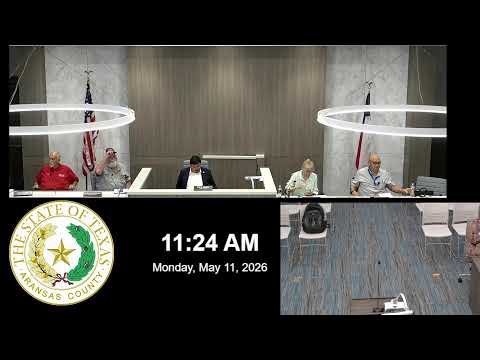
Rob Castillo, manager of the Railroad Commission of Texas's Special Injection Permits unit, told Aransas County officials at a May 11 workshop that the agency now has primary enforcement authority for Class 6 underground injection control permits for permanent CO2 geologic storage and is reviewing applications that could affect the county.
Castillo said the Class 6 program protects underground sources of drinking water (USDWs) and requires robust site characterization, well-construction standards, continuous monitoring and emergency-response plans. "Operators are required to model for at least the first five years of injection what the CO2 plume is going to look like," Castillo said, adding that monitoring plans typically include continuous plume tracking and groundwater testing.
The presenter said Texas applied for and received primacy for the federal Class 6 program after coordinating with the EPA, and the Railroad Commission will conduct public notices and local public meetings before issuing any permit. "I will be back here in Rockport whenever the permit is ready," Castillo said; he said public comment periods run 30 days and protests from affected persons can trigger administrative hearings.
On questions from commissioners and the public, Castillo confirmed there is currently one Class 6 application that affects Aransas County and that the application lists a location in offshore state waters. He said that while offshore state waters may lack USDWs in the same way onshore areas do, the agency's rules still prohibit contamination of protected groundwater and surface waters and that operators must show how they will protect those resources. Castillo said some application materials may be submitted as confidential business information but that the commission aims to be as transparent as allowed and will provide redacted applications on request.
Castillo outlined operator obligations including use of corrosion-resistant well materials, pressure and plume modeling, area-of-review delineation, corrective-action plans for legacy wells, financial assurance (letters of credit or surety) and post-injection site closure requirements. He also described pipeline oversight: inspectors are PHMSA-trained and monitor CO2 pipelines, which operate at high pressures and require welding and strict construction standards.
The Railroad Commission manager said permitting timelines are ambitious (the agency aims for about 180 days), but applications for Class 6 wells are complex and the review often takes longer. He estimated the current Aransas County-relevant application will take several months before a public meeting is scheduled. The commission encouraged affected landowners or stakeholders to contact its office to request application materials and participate in the public-comment process.
Next steps: the Railroad Commission will notify the county and hold a local public comment meeting when the application is ready for public review; any protests from affected persons would move the matter to the commission's hearings division for administrative proceedings.