Get Full Government Meeting Transcripts, Videos, & Alerts Forever!
Get email alerts on the Disaster Response topic
No spam. Unsubscribe anytime.
Trustees hear Molokai storm damage briefing; presenters urge more funding and coordination
Summary
Community leaders from Molokai told the Committee on Beneficiary Advocacy and Empowerment on April 29 that the Kona storm cut off homestead neighborhoods, caused mold in aging homes and strained supply lines; presenters asked OHA trustees for more financial and logistical support while an emergency declaration allows individual and public assistance.
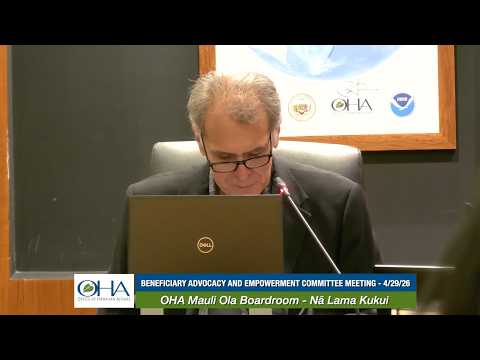
Members of the Office of Hawaiian Affairs Committee on Beneficiary Advocacy and Empowerment heard a briefing April 29 from Molokai community leaders about damage from the Kona storm and requests for more funding and coordination to help Hawaiian home communities recover.
The presentation, delivered by Koa McDonald and Cibbo Lopez, outlined immediate and long-term needs on Molokai, where storm surge, flooding and debris cut off access to several homestead settlements and damaged housing and infrastructure. "We do need help. We need resources and we are in meetings with your staff," McDonald said, asking trustees to sustain funding and operational support.
Why it matters: presenters said the storm damaged multi‑generational homestead households, created mold and health risks for elders, and disrupted the island's very limited supply chain — barges arrive twice weekly — making repairs and replacement materials slow and costly. Trustees said they would follow up with staff and consider additional financial support.
What presenters said: McDonald and Lopez described community mobilization — seven local food distribution hubs, debris removal, emergency roof repairs, tree trimming and mold remediation — and warned resilience will take many months. The presenters noted an emergency declaration enacted April 8 and said individual and public assistance programs are available, but getting aid to Molokai requires on‑island logistics and longer timelines.
Numbers cited in the record were inconsistent and spoken in different contexts: presenters referenced 25,769 acres on Molokai, roughly 840 leased parcels on the island and thousands on wait lists; statewide figures were also cited (figures given as approximately 203,000 acres and a wait list in the tens of thousands). Those counts come from presenters' remarks and the committee record and are summarized in clarifying details below; the committee did not provide an independent verification in the meeting.
Trustees' response and next steps: Trustee Alapa, who visited Molokai and participated in a check presentation to local organizations, praised local efforts and urged OHA to "step up a little bit more" to address urgent needs such as air purifiers for elders and funding for supplies. The presenters said they will continue meetings with OHA staff and trustees to map funding and distribution, and trustees directed staff to follow up.
Votes at a glance: During the meeting the committee also handled routine business. It voted to accept amendments to a proposed CD1 on SB93 relating to Hawaiian affairs (roll call recorded six yes votes and one other vote phrase in the transcript that was unclear); the committee approved its Feb. 4, 2026 minutes with seven yes votes and two trustees excused; and it adjourned after a roll call that recorded eight yes votes and one trustee excused.
The committee scheduled follow‑up coordination between Molokai presenters and OHA staff; trustees noted additional updates will be provided at subsequent meetings, including the Budget and Finance Committee convening at 11:00 the next day.