Get Full Government Meeting Transcripts, Videos, & Alerts Forever!
Get email alerts on the Criminal Justice Policy topic
No spam. Unsubscribe anytime.
Committee backs citywide ban on private detention centers, widens definition to include private ownership
Summary
The Land Use Committee recommended a favorable report for a bill that would bar private detention centers citywide. Sponsors expanded the draft to cover facilities owned or operated by private entities; agencies and dozens of community witnesses supported the measure. The committee adopted amendments and sent the bill to full council.
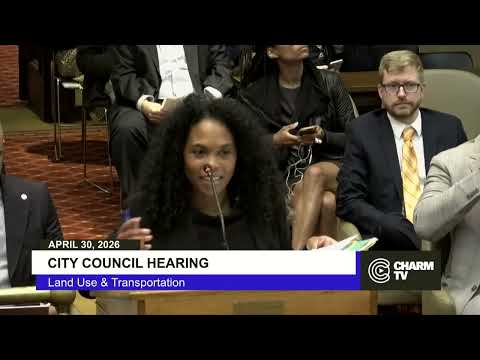
The Land Use & Transportation Committee on April 30 recommended a favorable report for a citywide zoning ban on private detention centers, voting to adopt three amendments that clarify exclusions and broaden the definition to cover facilities owned as well as operated by private entities.
Council President Zeke Cohen, who introduced the bill with co‑sponsors including Councilwoman Odette Ramos and Councilman Paris Gray, framed the proposal as an affirmative local measure to bar private, profit‑driven detention facilities from operating in Baltimore. “Baltimore should not monetize misery,” Cohen said, urging the city to protect immigrant neighbors and prioritize housing, transit and small business over detention capacity.
The committee heard that the Maryland General Assembly had already moved on a related prohibition; Cohen noted the state law and said the city text is broader in one respect — it would also cover private ownership, not only private operation.
Agencies largely supported the measure. The Planning Commission recommended favorable; the Baltimore Municipal Zoning Appeals office submitted a favorable note; the Department of Housing & Community Development and the Mayor’s Office of Immigrant Affairs supported the bill. The law department advised the committee that local restrictions can face federal preemption challenges in some circuits but that a carefully tailored, spatially limited local law is defensible; the department approved the bill as to form and legal sufficiency.
The committee adopted three amendments offered by Council President Cohen: a drafting update to ensure residential care facilities are explicitly excluded from the prohibition; a non‑substantive numbering fix; and a substantive clarification extending the definition of “private detention center” to include facilities owned by private entities as well as those privately operated at the direction of a government agency. The change was intended to close a potential loophole that would allow private ownership with government contracting to evade the ban.
The hearing drew broad public support: faith leaders, immigrant‑rights groups, students, labor unions and civil‑rights organizations testified that private detention facilities create incentives to detain people for profit, have documented harms (including inadequate medical care and deaths in custody) and undermine transparency and local accountability. Several speakers raised concerns about an existing campus safety roll‑call room at a local university that, they said, includes restraints and could function as a short‑term holding space; they urged careful drafting so no facility could be used to detain people in ways that evade oversight.
Action taken: The committee adopted the amendments and voted to recommend the bill favorable to the full city council. The council will consider the bill at a future full‑council meeting.
Quotations in this article are taken from the committee hearing transcript for April 30, 2026.