Get Full Government Meeting Transcripts, Videos, & Alerts Forever!
Get email alerts on the Land Use Parking topic
No spam. Unsubscribe anytime.
Residents and planners clash over parking, transit impacts for proposed West North Avenue grocery
Summary
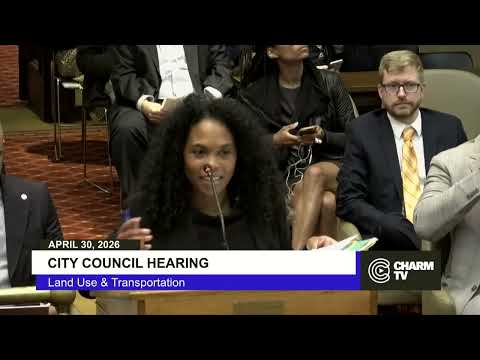
A proposed 12,000 sq ft grocery at 600 W. North Ave. prompted a long hearing April 30 after the developer requested a conditional use for alcoholic‑beverage sales and a variance to permit 65 off‑street parking spaces. Supporters say the store answers a food‑access gap; opponents say added parking and curbside changes threaten pedestrian safety and bus reliability. The committee held the item pending DOT/MTA follow‑ups.
The Land Use & Transportation Committee on April 30 heard several hours of testimony on a proposed 12,000‑square‑foot grocery and adjacent retail at 600 West North Avenue, including a conditional‑use request for alcoholic‑beverage sales and a variance seeking 65 off‑street parking spaces.
Councilman Torrance, the bill sponsor, framed the project as part of a multi‑year strategy to bring grocery options and other investment to the Wanada corridor. “This is an opportunity for us to get it right,” Torrance said, arguing the site can support a community‑oriented grocery that the neighborhood has requested.
The applicant, represented by Drew Tilden of Rosenberg Martin Greenberg, said the proposed Streets Market grocer and associated retail require more parking than the current zoning maximum to be financially viable. Tilden cited a market standard — 4.6 parking spaces per 1,000 square feet of grocery floor area — to justify the request for 65 off‑street spaces and said that without the variance the grocer would not lease the site.
But neighbors and transportation advocates strongly contested that approach. Christina Shappert Dero of the Community Law Center (speaking for the Historic Mount Royal Terrace Association) told the committee the preferred policy direction for North Avenue is transit‑oriented development, not suburban‑style parking lots. “This project would create new conflicts and potentially contribute to crashes,” she said, citing DOT’s earlier concerns about curbside conflicts with a bus lane.
Reservoir Hill Association President Kandra Prior and other residents emphasized that many nearby households do not own cars and that adding curbside and lot parking will raise costs embedded in food prices and make the street more dangerous for walkers and schoolchildren. Several speakers cited the corridor’s high injury statistics and urged that any changes be guided by a corridor‑level traffic analysis.
Planning staff reviewed the project and the Planning Commission recommended amendment and approval; the commission’s suggested edits include a revised site plan that identifies the specific portion of the property where alcoholic‑beverage sales would be permitted rather than authorizing alcohol for the entire grocery footprint. Planning staff and the commission also recommended replacing the plat with the revised site plan that shows the area intended for alcohol sales.
DOT and MTA raised the most pointed technical objections during committee discussion. DOT’s initial bill report noted concerns that curbside parking could diminish the effectiveness of dedicated bus lanes and create conflicts; DOT later updated that position in the file, saying many issues had been resolved after on‑site meetings and SPRC (Site Plan Review Committee) follow‑ups. Members asked DOT and MTA to provide written clarifications and a timetable for any required traffic or mitigation studies; Chair Dorsy requested a written response from DOT within 72 hours and an answer on how long a mitigation study would take by the end of the week.
The committee did not vote on the conditional use or the variance on April 30. Chair Dorsy paused the matter to allow the agencies’ written follow‑ups to be added to the record and to give members time to consider the technical traffic evidence.
What happens next: the committee will reconvene to consider the agency follow‑ups, including DOT and MTA traffic and enforcement analysis, before taking a vote on the conditional‑use request for alcohol sales or the requested parking variance. If the committee moves either item forward, the council would weigh the Planning Commission’s recommended amendments — most notably limiting alcohol sales to a specifically identified portion of the site — when drafting final language.
Quotations in this article are taken from the committee hearing transcript for the April 30, 2026 Land Use & Transportation Committee meeting; at the request of the committee, DOT will provide written clarifications and timing estimates for traffic analysis that the council expects to use before any final action.