Get Full Government Meeting Transcripts, Videos, & Alerts Forever!
Get email alerts on the Education Equity topic
No spam. Unsubscribe anytime.
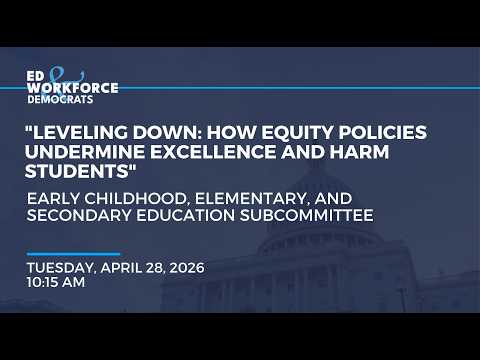
House hearing spotlights split over whether 'equity' policies lower academic standards
Summary
A House Education and Workforce hearing featured sharply divided testimony over whether equity-focused policies hurt or help student achievement. Republican members and witnesses argued changes to gifted programs, grading and charter rules lower rigor; Democratic members and civil-rights witnesses said equity and excellence can coexist and warned that federal rollbacks harm underserved students.
Chair opened a House subcommittee hearing by framing the debate around academic excellence, saying recent shifts toward equity have reduced expectations and harmed student achievement. "These are common sense principles and yet they are increasingly being abandoned," the Chair said in his opening remarks.
The session featured four witnesses: Daniel Buck of the American Enterprise Institute, Wayiwa Chin of the Chinese American Citizens Alliance of Greater New York, Michelle Turnage Young of the NAACP Legal Defense and Educational Fund (LDF), and Paul Runo of Defending Education. Each summarized written testimony and answered questions about gifted programs, grading practices, charter schools and the federal role in education.
The majority's witnesses argued that limiting gifted and talented programs, adopting so‑called equitable grading policies and constraining charter expansion have reduced academic rigor, harmed high achievers and failed the students they intended to help. Daniel Buck testified that removing acceleration options and lowering grading standards "accomplishes lower standards and depressed achievement," and pointed to San Francisco and New York City as examples where policy changes had negative effects.
Witnesses on the other side emphasized that equity‑focused practices, when well‑designed and evidence‑based, expand access and do not conflict with excellence. Michelle Turnage Young of LDF said, "Equity and excellence do not conflict," and pointed to research showing universal screening increases identification of disadvantaged students for advanced programs. She and others warned that recent federal actions and vague guidance have had a chilling effect on school programs and civil‑rights enforcement.
Members pressed witnesses in rounds of questioning. The committee chair repeatedly asked witnesses to confirm that gifted programs can be a pathway for low‑income students; several witnesses agreed they can, but emphasized the importance of objective and inclusive screening. Ranking Member Bonamichi focused on the federal role in funding and oversight, raising concerns about cuts to the Institute of Education Sciences and the Department of Education's capacity to enforce civil rights and administer programs like IDEA.
Several witnesses noted recent legal and administrative developments. Michelle Turnage Young said LDF prevailed in litigation that vacated 2025 Department of Education guidance perceived as vague and warned that threats to withdraw federal funds have prompted cancellations of school programs and events. The panelists offered differing policy prescriptions: some urged expanding gifted seats, restoring standards, and supporting charters; others urged investment in universal screening, civil‑rights enforcement, and federal supports for rural and high‑need districts.
The hearing concluded with partisan closing statements. The committee adjourned without a vote; members on both sides described further oversight and legislative options they plan to pursue.
The record remains open for 14 days for written statements and additional submissions, per committee rule.