Get Full Government Meeting Transcripts, Videos, & Alerts Forever!
Get email alerts on the Marina Redevelopment topic
No spam. Unsubscribe anytime.
Commission approves redevelopment of Blind Pass Marina with limits on outdoor music and dock variances
Summary
The commission granted a conditional use permit and four variances for the redevelopment of Blind Pass Marina at 9555 Blind Pass Road, approving an outdoor-restaurant concept with restricted live music, sound‑governor requirements, and dock reconstruction that reduces slips from 106 to 70; approvals were accompanied by conditions and unanimous votes.
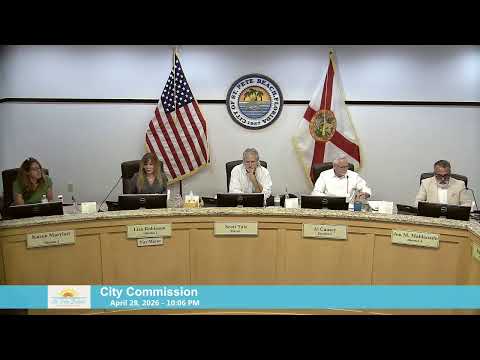
The St. Pete Beach City Commission on April 28 approved a two‑part redevelopment proposal for Blind Pass Marina, authorizing an outdoor restaurant with live music under a conditional use permit and granting four dimensional variances to reconstruct commercial dock facilities.
Brandon Barry, the city planner, told the commission that the site is a long‑standing marina and that recent hurricane damage and age had left facilities in need of complete redevelopment. The project retains the marina footprint but reduces overall slip count from 106 to 70 and increases individual slip size, the applicants said. The redevelopment proposal includes a largely open outdoor dining concept with a designated southern area for live performances.
To limit impacts on nearby residential properties, staff recommended and the commission adopted conditions requiring permanent, interior‑oriented speakers tied to a sound governor accessible only to management; a prohibition on outdoor music between 10:00 p.m. and 7:00 a.m.; decibel limits (65 dBA at the property line, 50 dBA inside a residential unit); and a requirement that two substantiated noise violations within a year automatically return the conditional use permit for commission review. The permit also requires operational upland facilities for marina users, pumpout capabilities or third‑party pumpout service, educational signage about nearby low‑speed zones, no long‑term dry storage of vessels without amendment, and that trailers and containerized structures be secured as permanent improvements.
The applicants told the commission they will use a mix of fixed central dock segments and floating docks at the margins to improve storm resilience; a marine engineering consultant said the design aims to be more resilient in future storm events and that Pinellas County sovereign submerged‑lands review will be required before construction. The city will also check the status of the submerged‑land lease renewal with the state as part of the permitting sequence. Several neighbors and yacht‑club representatives testified at the hearing, raising concerns about navigation, traffic, pumpout service and potential short‑term rentals; the applicant said it had met with neighborhood leaders and agreed to active management and outreach.
Both the conditional use permit and the variances were approved by the commission (separate votes), each with 5–0 tallies. Staff emphasized that county and state permits remain required for any work on submerged lands and that any material changes to the dock footprint that exceed what was approved locally would return to the commission.
Next steps: the applicant will pursue county and state permits for submerged‑lands work and proceed to site‑plan review for upland construction. The commission’s approval includes periodic review authority and specific conditions that staff will monitor for compliance.