Get Full Government Meeting Transcripts, Videos, & Alerts Forever!
Get email alerts on the Beach Signs topic
No spam. Unsubscribe anytime.
St. Pete Beach adopts emergency ban on sign posts within 50 feet of mean high water line
Summary
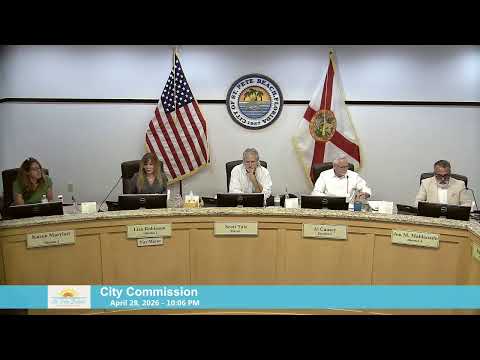
The City Commission voted 4–1 on April 28 to adopt Emergency Ordinance 2026‑10, prohibiting temporary, portable or permanent signs, posts and poles within 50 feet landward of the mean high water line to address safety and wildlife concerns; exceptions were made for government and permitted turtle/shorebird signage and for watercraft operators’ A‑frame signs.
The St. Pete Beach City Commission on April 28 adopted an emergency ordinance that prohibits single‑post signs, posts and poles within 50 feet landward of the mean high water line of the Gulf, citing safety risks from rebar and poles in the surf and protection of shorebirds and sea turtles.
City Attorney and staff framed the ordinance as a narrowly tailored response to “private encroachments on public beach” and presented the prohibition as a tool to remove rebar and other fixed posts that staff said create hazards for people and wildlife. The ordinance allows exceptions for official signs installed by federal, state or local government entities and for marine‑turtle or shorebird permit holders, and it preserves a city code provision that permits one portable A‑frame sign for licensed water‑sports operators within 40 feet of the visible waterline so long as the sign is removed each day.
The measure was approved as an emergency ordinance to take effect immediately; property owners were given seven calendar days to remove poles that conflict with the prohibition. The commission also approved a related first reading of a standard ordinance to follow the emergency measure so the change can be re‑considered in the coming weeks; emergency measures automatically expire after 60 days if a final reading does not occur.
The vote was 4–1 (Commissioner Cosy/Cosy/Cay recorded as voting no in the transcript). Several members of the public urged caution: attorney Alisa Gagnon told the commission the draft “appears viewpoint‑discriminatory” and likely to face First Amendment and state preemption challenges, and other speakers urged clearer mapping of the mean high water line and better public education about private versus public beach areas. Retired property owners and hoteliers asked the city to coordinate with the Pinellas County Property Appraiser and state survey records to ensure consistent enforcement.
City staff told the commission that mean high water line surveys are Title‑datum boundaries maintained by state surveys and that enforcement will focus first on the most obvious safety hazards (for example, poles in the water). The city also said it plans outreach and a community meeting/workshop during the 60‑day period before a final ordinance reading so stakeholders can suggest changes.
The ordinance as adopted contains a severability clause; the city attorney noted that if a court strikes particular exceptions, the remainder of the ordinance would remain enforceable. The commission instructed staff to publish the public‑notice materials and to prepare the follow‑up community meeting and first‑reading materials for the permanent ordinance.