Get Full Government Meeting Transcripts, Videos, & Alerts Forever!
Get email alerts on the Downtown Revival topic
No spam. Unsubscribe anytime.
Consultants say 4,000-person survey gives Harrisburg a public mandate for downtown revitalization
Summary
City-convened survey of downtown Harrisburg recorded more than 4,000 responses — including over 2,000 city residents and about 500 downtown respondents — and will feed targeted focus groups, tactical urbanism seed grants and a public workshop series to guide an autumn revitalization strategy.
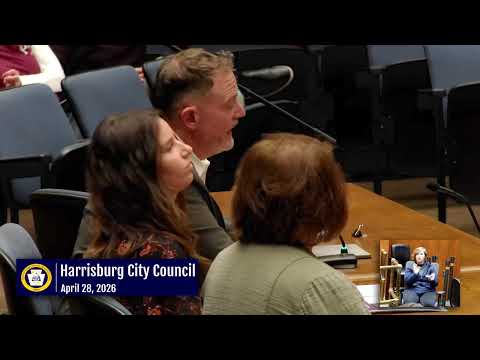
A city-funded perception survey of downtown Harrisburg drew more than 4,000 responses and will shape a push of public workshops, targeted focus groups and small, fast demonstration projects, presenters told City Council at its legislative session.
"We had over 4,000 participants," said Ryan Hunger, who introduced the presentation as a representative of the downtown revitalization partners, calling that level of response "the most that we have seen at a survey of this size." Hunger and the Pennsylvania Downtown Center presenters said the survey ran from February through April and was designed as a perceptual baseline — how people feel about conditions downtown rather than a technical assessment.
The Pennsylvania Downtown Center’s Iris Quigley told council the survey was intentionally broad and broken down to surface the views of residents, visitors, downtown workers, property owners and youth: "This is really how people are feeling and thinking of these different conditions," she said.
Julie Fitzpatrick, executive director of the Pennsylvania Downtown Center, said the raw participation numbers included "over 2,000" city residents and roughly "500" respondents who said they live downtown; about 20 percent of respondents left contact information saying they wanted to help moving forward. Presenters said the responses show clear strengths — strong architectural character, Riverfront Park and cultural anchors — and specific gaps: retail and grocery access, parking perceptions, lighting and sidewalk conditions, and ADA access.
Council members used the presentation to press on outreach equity. Vice President Jones and others asked how the consultants addressed the digital divide; Quigley said two focus groups were held at Harrisburg Housing Authority locations (Morrison Tower and Jackson Tower), engaging roughly 25–30 residents, and staff planned printed surveys and library-based access.
Presenters and council described a next phase that includes affinity focus groups (business owners, night economy employees, seniors), a summer series of public workshops and an autumn unveiling of a downtown revitalization strategy. Officials also flagged an immediate pilot grant program to seed tactical urbanism projects — short-term activations such as pop-up parks, pocket greening, expanded programming and beautification — using revitalization funds to create visible demonstrations while larger planning continues.
Council members and presenters repeatedly said safety and visibility were among the fastest-action concerns: brighter lighting, more consistent foot patrols and partnership with public safety and hospitality stakeholders. "Public safety is a major priority," Vice President Jones said, urging the new Responsible Hospitality Institute pilot and more coordinated marketing to change downtown perceptions.
The presentation concluded with an offer to make the full dataset and comparison tools available to council and the public. Council members and the presenters emphasized combining the survey's quantitative reach with local focus groups to reach underrepresented neighborhoods and youth as the city moves from data collection to specific projects and budget priorities.
Next steps noted by presenters included a May–July focus-group schedule, summer public workshops to draft vision statements and an inventory of possible projects for public support. The consultants recommended re-running the perceptual survey in future years to measure changes once projects are underway.