Get Full Government Meeting Transcripts, Videos, & Alerts Forever!
Get email alerts on the Data Privacy Legislation topic
No spam. Unsubscribe anytime.
House Energy and Commerce and Financial Services leaders unveil bipartisan Guard Financial Data Act to set national privacy standard
Summary
House Energy and Commerce Chair Brett Guthrie and House Financial Services Vice Chair Bill Huizenga outlined the Guard Financial Data Act, a bipartisan effort to update Gramm'Leach'Bliley with data-minimization, transparency, consumer access and deletion rights, opt-in for sensitive data, and agency enforcement; leaders said they plan regular-order advance through hearings and markups.
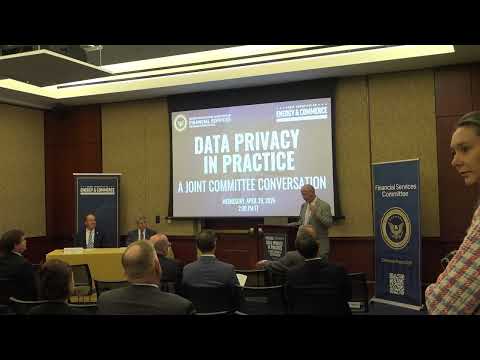
House Energy and Commerce Committee Chair Brett Guthrie and House Committee on Financial Services Vice Chair Bill Huizenga on the panel described a bipartisan push to create a single national privacy standard for consumer financial data, centered on a Financial Services bill called the Guard Financial Data Act and companion measures from Energy and Commerce.
Guthrie and other panelists said the measure builds on the Gramm-Leach-Bliley Act, which has governed financial privacy for about 25 years, and aims to reflect advances in data aggregation, artificial intelligence and cross-state commerce. "We want to make sure companies need to consent to collect sensitive personal data and people can opt out of targeted advertising and having their data sold," the Chair said, summarizing the proposal's consumer-facing protections.
The bill, as described on the record, emphasizes data minimization so financial institutions "only collect and share what's truly necessary," increased transparency about how and where data are used, and new consumer rights to access and in some cases request deletion of data held by financial firms. The proposal would require affirmative opt-in consent before sharing categories the bill classifies as highly sensitive personal information, while including operational provisions intended to prevent fraud and allow continuity of customer-initiated transactions.
Dr. John Joyce, who led a privacy working group, said leaders organized extensive stakeholder outreach to reach consensus: he cited roughly 250 requests for information and about 170 meetings with organizations and stakeholders. Joyce described a nine-member privacy working group that included members from a wide set of states and said the committees studied state laws as "laboratories of democracy" to shape a federal baseline. "You will have an opportunity to opt-out of automated decision making," Joyce said regarding AI-driven processes such as rapid loan decisions; "you will have a decision and it will be done by a human being," he added, describing a consumer option to avoid purely automated adverse decisions.
On enforcement and remedies, speakers said the bill relies primarily on agency enforcement by the Federal Trade Commission and state attorneys general rather than creating a broad private right of action. Panelists repeatedly noted that California'style private suits are limited in scope; the Chair and others cited agency fines as a primary enforcement tool and used illustrative penalty figures in discussion (the transcript included references to both $50,000 and $53,000 per violation/claim as examples raised during remarks).
Speakers also discussed special rules for children's data (the panel said the draft treats under 16 as a protected threshold but that discussions continue about whether to set 16 or 18), transition and proportionality for small institutions, and safe-harbor paths such as independent certifications for smaller businesses. Rep. Bill Huizenga said the legislation tries to strike a balance between empowering consumers and preserving workable compliance for small banks and local businesses, calling "trust" a guiding watchword for the approach.
Panelists urged that the bills proceed through "regular order" (subcommittee hearings, markups and full committee consideration) and asked associations and stakeholders to press for cosponsors and help secure time on a constrained House calendar. No formal committee votes or legislative action occurred during the event; the chairs said they expect hearings and a subcommittee markup as the next procedural steps.
The event closed with the chairs asking stakeholders to engage their members of Congress and associations to help build momentum for hearings and markups.