Get Full Government Meeting Transcripts, Videos, & Alerts Forever!
Get email alerts on the State Of City topic
No spam. Unsubscribe anytime.
Mayor Ashcraft delivers final State of the City, cites crime declines and housing, climate gains
Summary
Mayor Marilyn Izzy Ashcraft used her final State of the City address to highlight 2025 public‑safety improvements, housing and homelessness programs, climate action and infrastructure planning, while warning of looming structural budget deficits and ongoing federal funding uncertainties.
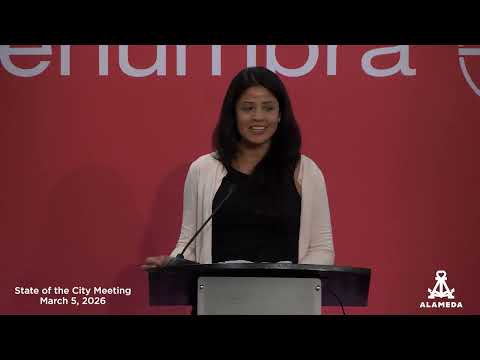
Mayor Marilyn Izzy Ashcraft delivered her final State of the City address to a Chamber‑hosted audience in Alameda, outlining multi‑year projects and recent results she said will shape the city’s future.
"It has been the honor of a lifetime and an incredible privilege to serve as mayor of this wonderful, vibrant city for the past eight years," Ashcraft said as she reviewed accomplishments across public safety, housing, climate and infrastructure.
Ashcraft opened by citing public‑safety gains in 2025, drawing on statistics presented by Police Chief Nishant Johi. She said the city recorded double‑digit reductions across major crime categories over two consecutive years, including a 45% drop in vehicle thefts, a 15% decline in larceny, a 14% reduction in vandalism and an 11% decline in burglaries. "Traffic enforcement with an emphasis on dangerous driving also increased in 2025 by 91%," Ashcraft said, adding that officers assigned to business districts have improved response times.
On emergency services, the mayor noted that the Fire Department placed Fireboat Neptune into service last year; the vessel can pump more than 4,000 gallons per minute and will serve Alameda and regional partners along the estuary, she said. Ashcraft also announced a forthcoming fire‑department strategic plan and a firefighter memorial at Station 3.
Housing and tenant protections were a centerpiece of the address. Ashcraft credited the City Attorney’s Office — led by Eban Shen — for securing rent protections for 150 units at Admiral's Cove, recovering more than $500,000 in invalid rent payments for tenants and obtaining a court victory that protected roughly 50 houseboat residents at Barnhill Marina. The Alameda County Superior Court, she said, issued a permanent injunction and imposed more than $335,000 in penalties on the marina owners to prevent further harassment of tenants.
The mayor outlined homelessness supports and new service capacity: the city will open a renovated day center and safe‑parking facility this fall that will offer overnight shelter, meals, showers and case management. Ashcraft also described the seasonal warming shelter (December 2025–April 2026) and city funding for an onsite case manager.
On housing production, Planning Director Alan Tai reported the city issued permits for 65 housing units in 2025, 52 of which were accessory dwelling units (ADUs). Ashcraft noted the city sold a dozen below‑market‑rate homes through a streamlined lottery and emphasized Alameda’s January 2025 designation as a pro‑housing city by the California Department of Housing and Community Development, which she said brought a $1 million grant and priority access to competitive funding.
Transportation and climate were recurring themes. The mayor described recent investments including Central Avenue safety improvements with Alameda’s first roundabouts, a protected two‑way cycle track on Grand Street, and Cross Alameda Trail upgrades. She said the city has reduced communitywide greenhouse‑gas emissions by 29% since 2005 and is on track to reach a 50% reduction by 2030. Alameda Municipal Power (AMP) continues grid‑reliability and electrification efforts, she added.
Ashcraft also highlighted local economic developments: Penumbra (a longtime Alameda manufacturer) will remain a standalone division and continue operations in the city following an acquisition; the Oakland Roots training facility will host the Australian men’s national soccer team as a 2026 World Cup basecamp, a move the mayor said will bring visitors and local spending.
The mayor balanced accomplishments with warnings about fiscal headwinds. Finance Director Ross McCarthy, Ashcraft said, has flagged projected structural budget deficits and the city is pursuing cost‑savings measures (banking changes, a fee‑study adjustment and reviews of internal service providers). The mayor also noted IT modernization and a responsible AI pilot as part of efforts to control costs and improve services.
Ashcraft acknowledged broader federal and regional uncertainties — including recent federal actions and a partial government shutdown that affected some partners — and described legal steps Alameda has joined to defend local authority and funding from federal conditions.
The program opened with brief public comments honoring the mayor. Assembly Member Mia Bont presented a resolution recognizing Ashcraft’s service, and Eden Chan, district director for Congresswoman Latifah Simon, delivered a congressional certificate of recognition. Brock Grunt, chair of the Alameda Chamber board, introduced volunteer board members and the mayor led a ceremonial oath for the Chamber leadership.
In closing, Ashcraft listed programs she said exemplify the city’s progress — from the Alameda Food Bank’s new permanent home and the RiseUp Alameda guaranteed‑income pilot to Dignity Village transitional housing — and thanked residents for their civic engagement during her eight years in office. "We have the capacity to meet any moment and the resiliency to rise to any occasion," she said.
What’s next: Ashcraft said the city is continuing the search for a permanent city manager, pursuing environmental reviews and funding for an estuary bridge and planning for possible voter consideration of a bond measure to address aging infrastructure and flood resilience.
Quotes used in this article are taken from public remarks at the Alameda Chamber’s 2026 State of the City event.