Get Full Government Meeting Transcripts, Videos, & Alerts Forever!
Get email alerts on the Public Safety Youth Programs topic
No spam. Unsubscribe anytime.
Committee keeps youth-oriented public safety funding but urges clearer goals and metrics
Summary
After extended debate, commissioners agreed to retain Measure U support for community service officer and youth-cadet programming but recommended breaking the public-safety line into distinct program elements with measurable goals for transparency and accountability.
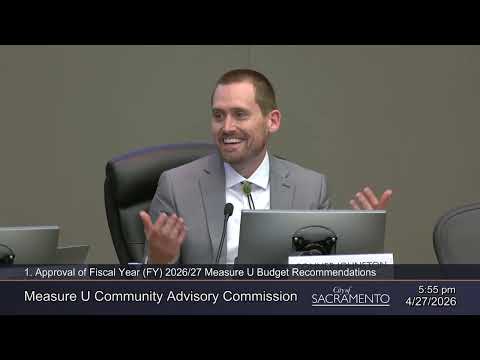
The Measure U Community Advisory Committee on April 7 decided not to cut funding for youth-facing public-safety programs — such as the community service officer (CSO) position and cadet pipeline — but told staff to separate the line into distinct program budget lines with clear goals and evidence-based metrics.
Members said the existing budget presentation made it difficult to evaluate value and transparency. "It is misleading to say that we're spending five or almost six million dollars to recruit people into jobs because that's not what's happening," one commissioner said during discussion of the CSO and hiring pipeline. Several commissioners argued that the programs function as youth development and public-safety investments and stressed the importance of measuring outcomes such as educational attainment, job placement and community-facing service results rather than raw headcounts.
The committee recommended splitting the single public-safety line into three entries — cadet program, CSO funding and the hiring pipeline — to allow each to be evaluated on targeted performance measures and to avoid the perception that Measure U funds are being used in ways that do not match ballot intent. Commissioners suggested metrics such as program participation by neighborhood, education and long-term outcomes for participants (graduation rates, college enrollment, employment in public safety roles) and recommended the ad hoc require departments to provide that data in future reporting.
The action is advisory; the City Council will set final budget allocations. The ad hoc committee was tasked with incorporating the committee’s direction on program definitions and recommended performance metrics into the final materials sent to the council.