Get Full Government Meeting Transcripts, Videos, & Alerts Forever!
Get email alerts on the Ethics Lobbying topic
No spam. Unsubscribe anytime.
Minn. ethics committee moves to executive session after complaint that Rep. Faulkner may have accepted paid government‑relations work
Summary
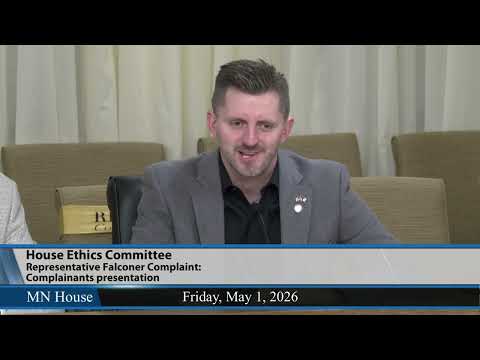
An ethics complaint alleges Rep. Faulkner accepted compensation for government‑relations work with an advocacy organization while serving in the Minnesota House; Faulkner and counsel denied he was a lobbyist and said he was on leave during session. The committee recessed to executive session to consider probable cause.
The Minnesota House Ethics Committee recessed into executive session on a complaint that Representative Faulkner may have accepted compensation for government‑relations work while serving as a legislator.
A presenter for the complainant opened the public proceeding by reading Minnesota statute §3.4 and House rules, arguing the record shows a pattern of overlap between Faulkner’s paid advocacy and his legislative activity, and pointing to a 4/15/2026 email sent by Faulkner to U.S. Senate offices that the presenter said constituted targeted outreach urging a particular congressional outcome. The presenter asked the committee to determine whether the conduct described in the record is consistent with the statutory prohibition on a sitting legislator accepting employment or compensation from a business whose primary revenue derives from lobbying or government‑relations work.
Counsel for Representative Faulkner, David of the Lockridge law firm, told the committee the complaint should be dismissed. He said Faulkner was not a registered lobbyist in Minnesota or federally during the relevant period, that the statutory prohibition the complainant cited applies to state lobbying activity, and that a straightforward reading of the rule does not support the complaint’s allegations. "He is not a lobbyist," counsel said, arguing there was no probable cause to proceed.
Representative Faulkner testified at length about his background and his work with Northeastern Minnesotans for Wilderness and the broader Save the Boundary Waters coalition. He said he was elected in November 2024, described long‑standing personal and constituent interest in protecting the Boundary Waters, and said his work for the organization has included strategy, education, fundraising and coalition building. Faulkner told the committee he was on leave during the legislative session and said his lobbyist registration had been terminated by the end of 2024. "I am no longer a lobbyist," he said, and described some reimbursed travel as community organizing and education rather than lobbying tied to his legislative duties.
Members pressed Faulkner on specifics: whether he received pay or reimbursements during the session, whether his job duties included direct government relations while he served, and why he authored bills supported by the coalition. Faulkner said he took paid time off (PTO) during session, planned to return to his employer when the Legislature was not in session, and that the bills he authored reflected campaign promises and constituent requests. He acknowledged drafting and circulating a coalition letter dated April 15 that he said he wrote as the bill author and as part of coalition outreach.
The committee did not make a public finding at the meeting. Following testimony and member questioning, a motion under House Rule 6.10 to recess for an executive session to consider probable cause passed with members responding "Aye." The room was cleared and the committee proceeded to executive session.
The complaint cites Minnesota statute §3.4 and House Rule 6.10; the record entered at the hearing includes lobbying‑registration documents, the April 15, 2026 email exhibit, and filings from the Minnesota Campaign Finance and Public Disclosure Board. The committee’s next public action will depend on what it determines in executive session about probable cause and any recommended corrective action or guidance.
What happened next: the committee recessed into executive session to consider whether to find probable cause on the complaint.