Get Full Government Meeting Transcripts, Videos, & Alerts Forever!
Get email alerts on the Surveillance Alpr topic
No spam. Unsubscribe anytime.
El Paso Council authorizes police grant application for license-plate readers after hours of public debate
Summary
After hours of public testimony and questions about vendor terms and data control, the council voted to authorize staff to submit state grant applications to sustain automated license-plate reader (LPR) operations, removing a vendor-specific reference and directing legal safeguards.
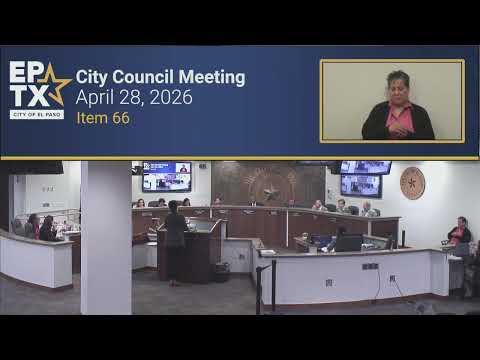
The El Paso City Council on April 28 authorized the city manager to submit state grant applications to fund continued license-plate reader (LPR) operations used by the El Paso Police Department, after an extensive public debate about surveillance, data control and vendor terms.
The vote followed a presentation by Assistant Chief Ombberto Talamantes, who outlined the department’s experience with LPR technology over the past year and said the system has aided vehicle-theft investigations, the recovery of stolen vehicles and the identification of suspects. Talamantes told council the department limits access to the LPR portal to trained investigators, uses multi-factor authentication and runs regular audits of records access.
Opponents and privacy advocates pressed council members for changes. Multiple speakers—including community organizers, civil-liberties advocates and local residents—argued that broad, vendor-controlled networks can permit access beyond municipal control, and that recent changes in some vendors’ online terms and service warrant caution. Speakers cited out-of-state examples where data-sharing or employee access created community concern and urged the council to require stronger contractual protections before approving renewal or continued use.
Council amended the grant paperwork to remove a vendor-specific reference and direct staff to use more general LPR language in the application. The amended motion passed after repeated procedural votes; the council also directed the city attorney and staff to insist on contractual protections if a vendor requires terms inconsistent with local policy. The grant authorizations will allow the department to fund overtime operations and other eligible items for a 12-month grant period if awarded.
What changed and what happens next
- City staff will file the applications with the Motor Vehicle Crime Prevention Authority (two related grants were discussed) using general LPR language rather than naming a specific vendor. - If grants are awarded, the city will have funding for additional anti-theft operations and related items; any future vendor contract will be reviewed by the city attorney and purchasing staff and brought forward according to procurement rules. - Council members and several public speakers asked for stronger, written contractual guarantees (data ownership, audit logs, limits on disclosure, dispute jurisdiction) before any long-term renewal.
The council’s action preserves the police department’s ability to seek grant funding for LPR-driven anti-theft work while requiring staff to pursue legal and procurement safeguards before entering or renewing long-term licenses that could affect how municipal data are used or shared. The department said it will continue to publish a transparency portal with answers to common questions and to report out audit results on access.