Get Full Government Meeting Transcripts, Videos, & Alerts Forever!
Get email alerts on the Live Entertainment Policy topic
No spam. Unsubscribe anytime.
City staff outline 18-month pilot to ease indoor live-entertainment rules in Reno
Summary
City of Reno Development Services proposed a limited 18-month pilot to exempt some new indoor live-entertainment uses in core entertainment areas from the conditional-use-permit process, in exchange for a no-fee security plan and continued cabaret licensing; staff said enforcement will rely on existing resources and resident complaints.
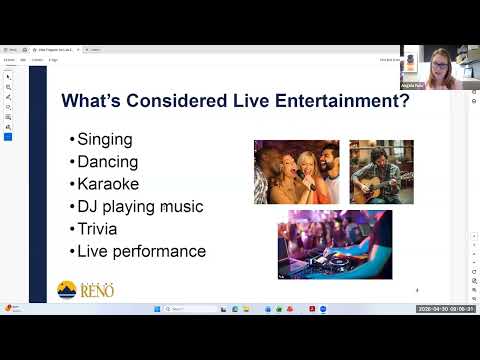
City of Reno development staff on a virtual public feedback meeting detailed an 18-month pilot that would allow certain new indoor live-entertainment venues in parts of downtown, Midtown and East Street to operate without the usual conditional-use-permit (CUP) review so long as they submit a no-fee security plan and obtain required cabaret licensing.
Angela Fouse of the cityDevelopment Services said the pilot responds to council direction to be more business-friendly while keeping safeguards for residents. "We want you to have live entertainment, but we're going to put some limitations on what that looks like," she said, adding the exemption would apply only to indoor activities in areas that already permit 24-hour uses.
Under current code, staff said, indoor live entertainment is allowed until 11 p.m.; after 11 p.m. a CUP is required, a parcel-specific process that staff estimated takes about three months. The proposed pilot would temporarily exempt some new operators from the CUP for 18 months so staff can evaluate whether the combination of the exemption and a required security plan effectively balances economic and residential interests.
The security plan would be submitted at no charge and reviewed by Planning, Code Enforcement, Business License and the Reno Police Department. Staff described the plan as a checklist that asks venues to address crowd control, bouncer training, weapons procedures and other operational measures. If complaints persist, Fouse said staff would return to the operator to amend the plan and, in repeated or severe cases, could revoke a cabaret license so a venue could no longer offer live entertainment.
Fouse described the pilotas geographically limited to RenoMidtown, Virginia Street/downtown and East Street where 24-hour uses already exist, and said existing businesses would be grandfathered and not required to submit new security plans.
Staff said the 18-month window was chosen to capture more than one busy season and produce meaningful evaluation data. "If we find that it's not working and we don't like it, we can always pull it back and stop it," Fouse said, outlining a schedule that includes Planning Commission consideration in May and City Council action in June.
Public commenters raised concerns about the removal of the CUP process, arguing it eliminates neighborhood notice and formal public input tied to individual parcel reviews. Art Rangel read an email from resident Gary Ceil that asked the city to define evaluation criteria and metrics, specify who will measure and independently audit results, and clarify enforcement capabilities before proceeding. Fouse said staff intends to include community feedback in the packet to Planning Commission and Council and will use complaint data (calls to Reno Direct and 911) to trigger enforcement follow-up.
On enforcement tools, staff said the city has invested in 48-hour noise meters that provide better evidence of persistent noise than handheld spot checks; staff has not adopted continuous smart-sensor networks but said further equipment purchases would be a Council decision as part of the broader noise discussion.
Next steps: staff will post the two webinars, the PowerPoint and draft code language on the City of Reno Initiatives and Updatesweb page; Planning Commission will review the pilot next week and Council will consider it in June. After roughly 18 months staff will report back to Council with findings and a recommendation on whether to make the change permanent, modify it or end the pilot.
The meeting closed with Chamber representative Ann Silver urging continued work to balance downtown vibrancy and residentsquality of life; staff asked for written comments via email and the project webpage to inform the Planning Commission and Council packets.