Get Full Government Meeting Transcripts, Videos, & Alerts Forever!
Get email alerts on the Municipal Budget topic
No spam. Unsubscribe anytime.
Bridgeport proposes largely stable FY2027 budget, citing health insurance increases, revaluation and debt refinancing
Summary
City officials told the budget committee the FY2027 general fund is broadly stable after a revaluation that allows a lower mill rate; major cost pressures include a 12'14% rise in health insurance, reduced federal ARPA support and proposed debt restructuring that officials say will save future budgets about $10M annually.
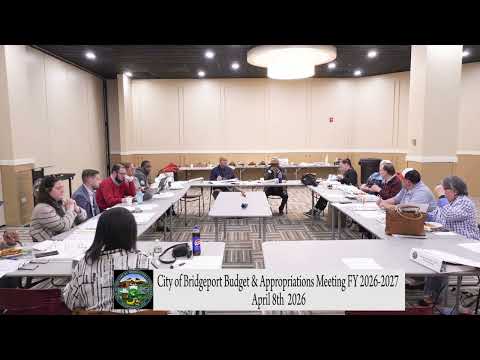
Bridgeport City's budget team presented the mayor's proposed fiscal year 2027 operating and general fund budget to the budget committee, saying the plan holds the overall tax burden steady despite large cost pressures.
Ken, the city's OPM/finance presenter, told the committee the city faces ‘‘uncontrollable''cost drivers’’ including a national 12'14% rise in health insurance and higher utility and inflationary costs, and that federal American Rescue Plan (ARPA) funds that previously supported one-time items are phasing out, reducing revenue by roughly $10 million next year.
The administration also described a one-time accounting change: the school nutrition program, historically shown in the general fund at about $25 million, has been reclassified into a grant fund (Fund 90). Ken said that shift makes the headline general fund total appear lower (about a $22 million drop) without cutting the nutrition service itself.
Tom, speaking for the CEO's office, framed the budget's larger priorities. He cited economic-development projects (downtown demo and redevelopment, Steel Point, PSCG site demolition backed by a $22.5 million state grant), school capital investments, and steps to stabilize the city's long-term debt profile. Ken described a planned partial refinancing and restructuring of near-term debt to smooth payments so that, as pension bonds retire in about six years, annual debt service drops; the refinancing is projected to free up roughly $10 million a year in future budgets and will require a council resolution.
The administration proposed lowering the mill rate because of a recent revaluation that increased property values: ‘‘the mayor's proposing a mill of approximately 27.75 mills,’’ Ken said. Officials warned that because revaluation outcomes vary across property types, some taxpayers will see cuts while others may see increases; they also noted car tax bills should fall because vehicle values are checked yearly while the mill rate is dropping.
On revenues and offsets, Ken said building permit revenue is projected to rise modestly, the fire department will pilot new fee-based training services (about $60,000 projected), and the parks program will absorb a change in resident beach pass policy that reduces revenue by roughly $300,000 while preserving nonresident revenue streams. He also said the city trimmed planned surplus/retro reserves and increased an attrition assumption to reflect higher-than-budgeted vacancy rates.
Committee members pressed about staffing and contingencies. Ken said the rainy-day fund stands at about $59 million (roughly 8'9% of the budget), near rating-agency guidance, and that the administration included several targeted personnel additions where departments provided documentation of need. He noted overall health-insurance increases added about $5 million to the city's cost base and that actuarially required pension contributions also rose for older plans.
The committee voted to accept the budget handouts and a revised FY2026'27 strategic budget goals document as exhibits for review. The administration said it will return with department-level details at subsequent sessions.
What happens next: the administration will present the formal refinancing resolution in the spring and the council will vote on the mill rate in the coming weeks; department budget hearings were scheduled to follow for line-by-line review.